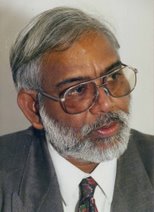
Open your eyes, your Lordship (retired)
JOHN DAYAL
As a Malayalee who was also a judge of the Supreme Court of India, Justice Kallupurackal Thomas Thomas occupies an enviable place in the Kerala Christian social pantheon. No one in his right mind will dare say he is turning senile. Far from it. That man of justice, and of peace, remains as sharp as when he was on the highest Bench in the land. It therefore remains a mystery why Justice Thomas, invited often by right wing forums in his twin identity as jurist and Christian, always ends up praising the Hindutva lunatic fringe and denouncing the conversions of new people turning to Christ.
In an address in Kochi on 1 august 2011, Justice Thomas praised the RSS for its discipline and said the propaganda that the organisation was anti-minority was "baseless". The Press Trust of India reported that speaking at a function here, attended by RSS chief Mohan Bhagwat, he also said the ''smear campaign'' against RSS that it was responsible for the assassination of Mahatma Gandhi must end. “There is a smear campaign that RSS was responsible for Gandhi’s assassination just because the assassin was once an RSS worker," he said, adding that the organisation had been ''completely exonerated'' by the court. This smear campaign must end against RSS," he said.
Gratuitously, Justice Thomas sought to expand his personal views to make them seem he spoke for the entire Christian community, including you and me. “I am a Christian. I was born as a Christian and practise that religion. I am a church going Christian. But I have also learnt many things about RSS," he said. He said he became an admirer of the RSS in 1979 when he was posted as district judge of Kozhikode, adding simple living and high thinking was its hallmark. During the Emergency, RSS was the only non-political organisation which fought against it. "We owe very much to RSS for sacrificing many lives for regaining our fundamental rights ...". "The propaganda that RSS was anti minority was also baseless," he said, adding he is a great admirer of the organisation as discipline is given importance.
This writer share some qualifications with the venerable justice. Like him, “I too am a Christian, a Catholic as a matter of fact. I was born as Christian and practice that religion. I am a church going Christian. But I have also leant many things about the RSS.”
One may in fact have learnt many more things about the Rashtriya Swayamsevak Sangh, for when he was rapidly going the ladder of jurisprudence, Reporting on the RSS forty years ago, visiting their shakhas, recording what their leaders said, and documenting their written statements and literature, one saw the training of youngsters and college students, and the excesses of fat pot bellied middle agenda traders in khaki shorts and white shirts, an hour before they went back to their shops in Chandni chowk and Chawri bazaar, the wholesale market of old Delhi.
It was perhaps too early in the day,, because one did not see what crowds in Jhansi saw decades later -- the frightening scene of RSS cadres practicing with mock and real rifle and double barrelled guns down the main thoroughfares of town, or of RSS chief ministers themselves firing military hardware while posing for photographs. But one did see how RSS cadres were trained in meetings early morning in public parks as much as in closed door vyayamshalas, their “boudhiki” intellectual brain washing, and their war games. “Exercises” no less frightening –elaborate handwork with thick lathis, or staves, the sort policemen carry at night. One also saw “children’s games” in which boys formed a string holding hands, and then swopped down on a rival group, trying to “abduct” or capture persons, presumably women. The “boudhikis” were given to reading the editorials and main articles in those poison-pen official mouthpieces of the Sangh, the Organiser in English, not read at the Shakhas, and the Hindi language Panchjanya, the mainstay of the morning discourses. They would then discuss what damage the Muslims had done to India. It would all conclude with another salute not to India, but to a mythical “Mother India”, more goddess than a symbol of the land which they shared with practitioners of all other religions.
And therefore it is quite obvious that Justice Thomas, as is his right, looked only at the pretty saffron flowers, and forgot to look at the blood which sullies the earth on which the RSS flag is hoist.
First things first. Let us get the Gandhi murder out of the way, so to say. And I am indebted to Professor Shamsul Islam, the global authority of the Sangh Parivar, for once again going me this documentary evidence. He remains, with Communalism Combat, Anhad, Sahmat and the All India Christian Council, the national libraries on this fascist organisation.
After the murder of Mohandas Karamchand Gandhi on January 30, 1948 the RSS was banned on February 4, 1948. It was banned for anti-national activities and the government communiqué banning the RSS was self-explanatory: “In their resolution of February 2, 1948 the Government of India declared their determination to root out the forces of hate and violence that are at work in our country and imperil the freedom of the Nation and darken her fair name. In pursuance of this policy the Government of India have decided to declare unlawful the RSS.” [Cited in Justice on Trial, RSS, Bangalore, 1962, p. 64.]
The communiqué went on to disclose that the ban on the RSS was imposed because,” undesirable and even dangerous activities have been carried on by members of the Sangh. It has been found that in several parts of the country individual members of the RSS have indulged in acts of violence involving arson, robbery, dacoit, and murder and have collected illicit arms and ammunition. They have been found circulating leaflets exhorting people to resort to terrorist methods, to collect firearms, to create disaffection against the government and suborn the police and the military.” [Ibid, pp. 65-66.]
Prof Islam points out that the then Home Minister, Sardar Patel, reputedly had a soft-corner for the RSS. Patel continues to be a favourite with the RSS. However even Sardar Patel found it difficult to defend the RSS in the aftermath of Gandhiji’s assassination. In a letter written to the head of the RSS, Golwalkar, dated 11 September 1948, Sardar Patel stated: “Organizing the Hindus and helping them is one thing but going in for revenge for its sufferings on innocent and helpless men, women and children is quite another thing…Apart from this, their opposition to the Congress, that too of such virulence, disregarding all considerations of personality, decency or decorum, created a kind of unrest among the people. All their speeches were full of communal poison. It was not necessary to spread poison in order to enthuse the Hindus and organize for their protection. As a final result of the poison, the country had to suffer the sacrifice of the invaluable life of Gandhiji. Even an iota of the sympathy of the Government, or of the people, no more remained for the RSS. In fact opposition grew. Opposition turned more severe, when the RSS men expressed joy and distributed sweets after Gandhiji’s death. Under these conditions it became inevitable for the Government to take action against the RSS…Since then, over six months have elapsed. We had hoped that after this lapse of time, with full and proper consideration the RSS persons would come to the right path. But from the reports that come to me, it is evident that attempts to put fresh life into their same old activities are afoot.” [Ibid, pp.26-28.]
Hindu Mahasabha and RSS were jointly responsible for the murder of Father of Nation, Mahatma Gandhi, this fact was further corroborated by Sardar Patel in a letter to a prominent leader of Hindu Mahasabha, Shyama Prasad Mookerjee on July 18, 1948. Sardar wrote: "As regards the RSS and the Hindu Mahasabha, the case relating to Gandhiji’s murder is sub judice and I should not like to say anything about the participation of the two organizations, but our reports do confirm that, as a result of the activities of these two bodies, particularly the former, an atmosphere was created in the country in which such a ghastly tragedy became possible. There is no doubt in my mind that the extreme section of the Hindu Mahasabha was involved in the conspiracy.
The activities of the RSS constituted a clear threat to the existence of Government and the State. Our reports show that those activities, despite the ban, have not died down. Indeed, as time has marched on, the RSS circles are becoming more defiant and are indulging in their subversive activities in an increasing measure.” [Letter 64 in Sardar Patel: Select Correspondence19450-1950, Volume 2, Navjiwan Publishing House, Ahmedabad, 1977, pp. 276-277.]
Congress secretary general Digvijay Singh, who was for ten years chief minister of Madhya Pradesh, and Union Home ministered P Chidambaram are supported by historical data when they called a focus on right-wing terror groups, specially the progeny of the RSS. Chidambaram recently has favoured a proper research and study of the phenomenon, asking the security forces to deal with the right-wing terror groups "sternly and fearlessly". He said that these groups were also radicalising the youth in the same manner as was done by banned SIMI or Indian Mujahideen. There was no difference between Indian Mujahideen and Hindu terror groups and both were enemies of the country."..so actually, we do not have one enemy within today, we have two enemies within and hope there will not be a third or a fourth or fifth," Chidambaram said.
Digvijay Singh has repeatedly said “I do not rule out anything. If they want evidence about Sangh’s involvement in terror activity, I have got evidence”.
Just in case Justice Thomas, and his friends such as Karnataka Minority commission member P N Benjamin, whose organisation BIRD provides occasional platform for the former judge’s fulminations and homilies, require judicial evidence, here is a brief summary of extracts from a series of judicial commissions that have investigated the role of the RSS in anti-Muslim violence since the Ahmedabad riots of 1969. That is over forty years of history.
"Here was not only a failure of intelligence and culpable failure to suppress the outbreak of violence but (also) deliberate attempts to suppress the truth from the Commission, especially the active participation in the riots of some RSS and Jana Sangh leaders." — Report of the Justice Jagmohan Reddy Commission on the Ahmedabad riots of 1969
“The organisation responsible for bringing communal tension in Bhiwandi to a pitch is the Rashtriya Utsav Mandal. The majority of the leaders and workers of the Rashtriya Utsav Mandal belonged to the Jan Sangh (the predecessor of the BJP) or were pro–Jan Sangh and the rest, apart from a few exceptions, belonged to the Shiv Sena.” — Report of the Justice D.P. Madon Commission on the Bhiwandi, Jalgaon and Mahad of 1970
“In Tellicherry the Hindus and Muslims were living as brothers for centuries. The ‘Mopla riots’ did not affect the cordial relationship that existed between the two communities in Tellicherry. It was only after the RSS and the Jana Sangh set up their units and began activities in Tellicherry that there came a change in the situation. Their anti-Muslim propaganda, its reaction on the Muslims who rallied round their communal organisation, the Muslim League which championed their cause, and the communal tension that followed prepared the background for their disturbances....That is what the rioters who attacked the house of Muhammad asked him to do. “If you want to save your life you should go round the house three times repeating the words, ‘Rama, Rama’. Muhammad did that. But you cannot expect the 70 million Muslims of India to do that as a condition for maintaining communal harmony in the country. This attitude of the of the RSS can only help to compel the Muslims to take shelter under their own communal organisation.” — Report of the Justice Joseph Vithyathil Commission on the Tellicherry riots, 1971
"The RSS adopts a militant and aggressive attitude and sets itself up as the champion of what it considers to be the rights of Hindus against minorities. It has taken upon itself to teach the minorities their place and if they are not willing to learn their place to teach them a lesson. The RSS methodology for provoking communal violence is: a) rousing communal feelings in the majority community by the propaganda that Christians are not loyal citizens of this country; b) deepening the fear in the majority community by a clever propaganda that the population of the minorities is increasing and that of the Hindus is decreasing; c) infiltrating into the administration and inducing the members of the civil and police services by adopting and developing communal attitudes; d) training young people of the majority community in the use of weapons like daggers, swords and spears; e) spreading rumours to widen the communal cleavage and deepen communal feelings by giving a communal colour to any trivial incident."— Report of the Justice Venugopal Commission on the Kanyakumari riots of 1982 between Hindus and Christians
"The dispute on the route of the procession became sharp and agitated reactions from a group of persons calling themselves the Sanyukt Bajrang Bali Akhara Samiti who systematically distributed pamphlets to heighten communal feelings and had organisational links with the RSS. A call for the defiance of the authority and the administration when it refused permission for one of the routes led to a violent mob protesting and raising anti–Muslim slogans and thereafter an incendiary leaflet doing the rounds of Jamshedpur that is nothing short of an attempt to rouse the sentiments of Hindus to a high pitch and to distort events and show some actions as attacks on Hindus that appear to be part of a design. A survey had already established that all policemen, havaldars, home guards etc. were at heart ready to give support to them (Hindu communalist organisations)." — Report of the Commission of Inquiry into the Communal Disturbances at Jamshedpur, April 1979
“Even after it became apparent that the leaders of the Shiv Sena were active in stoking the fire of the communal riots, the police dragged their feet on the facile and exaggerated assumption that if such leaders were arrested the communal situation would further flare up, or to put it in the words of then Chief Minister, Sudhakarrao Naik, “Bombay would burn”; not that Bombay did not even burn otherwise.” — Report of the Justice B.N. Srikrishna Commission on the Mumbai riots of 1992–1993
Justice Thomas is invited to look up the full reports ,if he wishes too.
It would help the Church leadership, too, if it were to read those reports.
[ends]
Sunday, August 14, 2011

Just a moment, Mr Narayan Murthy
Not suggesting a coup, Infosys Murthy?
Billionaire Narayana Murthy owes an explanation for his slur against Sonia
JOHN DAYAL
Mohandas Karamchand Gandhi, of course had the backing of the billionaires of his time, the Ghanshyamdas Birlas and the Jamnalal Bajaj families, if not of the Tatas who could be presumed to be leaning just a trifle towards the British with whom their community identified so strongly. Jawaharlal Nehru, with his perceived socialist political ideology, was all but an anathema to India’s industrial, corporate and business classes, and the landlords, who inevitably drifted towards the Swatantra party and eventually found a safe haven in the bosom of the Jana Sangh which is now the Bharatiya Janata party. So was Nehru’s daughter, Indira whose sweeping nationalisations of vital sectors such as banking and finance left the rich seething with suppressed anger.
Analysts understand this angst. This is a global phenomenon, as much as corruption and nepotism. Money bags in India or in the US want governments under their control. Historically, in India from the times perhaps of Dhhana Seth and Jagat Seths, Marwari money princes who financed caravans and armies going past their strategic locations in the Rajputana, money has also meant political clout. In the recent corporate history of India since Rajiv Gandhi, India’s corporate sector has sought liberation from the “Permit Raj” or stifling government regulations made in the public interest to prevent profiteering. But the same industrialists, including such giants as the Ambanis, have sought protection from western monopoly capital. That would seem strange to anyone with reason, but such is the logic of high competition.
While the middle and small traders continued with the BJP, it was being presumed that big industry had developed a soft corner for Rajiv Gandhi with his modernistic views and futuristic vision, and because of the thrust to technology that he gave during his short five year term in government.
The drift towards the Congress became a flood, again in perception, when Prime Minister Narsimha Rao brought in as Union Finance Minister the International Monetary Fund former economist Dr Manmohan Singh [and with him such luminaries as Planning Commission deputy chairman Dr Montek Singh Ahluwalia] and launched the liberalisation of the Indian economy. Despite a BJP interlude in power as the National Democratic Alliance for six years or so, with Dr Manmohan Singh’s advent into power as Prime Minister in United Progressive Alliance One and Two, one would have thought the Corporate sector, better known by its euphemism “India Inc.” were now firmly fixed in the Congress corner.
This of course did not happen.
Dr Manmohan Singh’s coalition regime’s fast-paced liberation in UPA-I has understandably sought time to consolidate in UPA-II. The rise in poverty, the land acquisition tension are all signs that the government is working for big business and not for the poor man in the parched fields. But this so called delay has created suspicion among India Inc.
It is not surprising that the biggest boys in industry support the BJP, and go as far on the limb as to support Narendra Modi, that icon of Hindutva and that persecutor of those who oppose him, specially Muslims. His role in the mass murder of Muslims in Gujarat in 2002 is well documented, and is now before the courts at various levels of investigation by a multitude of central and state agencies.
Two years ago, in an infamous statement, Ratan Tata, Sunil Mittal and Mukesh Ambani endorsed Narendra Modi as the “Next Prime Minister”
Fortunately, there was a popular uproar, and the troika was condemned in no uncertain terms. Political elements also took on big business and questioned its morality and short-sightedness, as much as its collective amnesia in forgetting what bloodletting had taken place in Gujarat. Ratan Tata got his small car project in Gujarat, but stopped carrying his love for Modi on his sleeve. His involvement in the Radia Tapes, which he has challenged in court, further silenced him as far as political indiscretions were concerned. The 2- G Scam has also made the Ambanis and the Mittals beat a hasty retreat from the public microscope.
It seems to have, however, taught no lessons to Infosys founder and chairman N R Narayan Murthy. Unless of course one were to argue that Murthy’s recent statement is part of an elaborate strategy to sow seeds of dissent and de-stabilisation in the UPA and the Congress with a much deeper conspiracy or agenda which could include a split in the Congress, the formulation of a new ruling alliance which marginalises the Nehru-Gandhi family. These have been tried before, the most recently during the Narsimha Rao era.
In an interview with the New Delhi Television channel 24x7, Murthy said UPA-II had failed to move ahead with reforms despite being in office for over two years. He put a part of the blame on the dual leadership structure with Prime Minister Manmohan Singh heading the government while Sonia Gandhi controlled the party. "You know, I mean, I understand that he (Singh) leads a coalition. I understand that we have two leaders in the whole set-up. There is a leader of the party (Sonia), there is a leader of the government. So, all these things do slow down the decision-making; but I think that's precisely why the reason that the prime minister must, in fact, take acute note of that and perhaps accelerate decisions," Murthy told NDTV.
As news reports said, the Infosys founder, who is due to step down, was highly critical of the slowdown in decision-making. In the past too, he had expressed concern over corruption but his remarks coincide with those made by the Prime Minister's Economic Advisory Council, which is headed by C Rangarajan, a close aide of Singh. The panel of economists had blamed the government's preoccupation with corruption-related controversies for going slow on decision-making. "Well, you know we have a culture of taking slow decisions, we have a culture of dithering. This is not just at Delhi, it happens in every state. It happens in corporations, it happens in educational institutions. Therefore, the need of the day is for all of us to realise that nothing is gained by dithering. Nothing is gained by postponing decisions. You have to take decisions quickly, no matter that they appear unpalatable in the short term. Well, if I look at the facts and data, then it is true that we haven't had, or you know, taken any decisions ever since this government came back to power in 2009. Which means it is already two years and about three months old. So, to that extent, I think we should all be concerned," Murthy said.
Incidentally, Murthy also spoke out against corruption saying economists have argued that graft shaved off 0.5 to 1.5 percentage points from economic growth. By controlling inflation, India could have growth at double-digit rates. And he had some advice for politicians too. "It's a good idea to have politicians retire at 60."
He did not speak against business dynasties, though his own son has not succeeded him at Infosys but will, of course, inherit much of his wealth regardless.
It is not that Murthy alone is concerned at the slowdown in the economy which robs them of some profit taking, specially for service sector tycoons who do not have much stakes in the long term vision of brick and mortar companies. Newspapers have carried warnings by various corporate leaders on the “policy paralysis” . One such outburst was at a meeting tycoons had with Union Finance Minister and trouble shooter Pranab Mukherjee . The minster brushed aside suggestions of policy paralysis, saying it was perception,
Those who keep a keen eye on India Inc have said they are not surprised at all that Murthy said what he said, and how he said it.” With success comes hubris. This seems to have hit Narayana Murthy too. One tends to believe that I am successful, so I must be right. Whatever I think, say and do must be right. Because if I was wrong, I couldn't be successful, my company couldn't be successful. So I am right. Since I am right, I have a right to lecture the world on what is right,” blogged one critic.
He was commenting on Narayana Murthy's writing in a recent issue of Smart Manager, reproduced by Rediff.com on its website. The article starts off with describing and defining leadership, mostly quoted from Robert F Kennedy and Mahatma Gandhi. “Sadly, Murthy has started off on a wrong note. Many of the quotes in his article apply equally well to leaders of the wrong sort, which Narayana Murthy has in mind. "Leadership is about raising the aspirations of followers and enthusing people with a desire to reach for the stars. For instance, Mahatma Gandhi created a vision for Independence in India and raised the aspirations of our people." So did Hitler, said the blogger. Or Chairman Mao. “It is good to use Mahatma's name to justify your statement. Only, when you take Mahatma's name, be careful that what is attributed to Mahatma or Martin Luther King does not apply equally well to Adolf Hitler and Vladimir Lenin. But it does. Good leaders need not always be impeccable men. While trying to describe leadership, Narayana Murthy unknowingly puts leaders of all kinds into the same box. He fails to distinguish the ideal leadership strain that he has in mind, thereby putting great names to disrepute.”
There is nothing theoretical when Murthy talks so directly of Sonia Gandhi and Manmohan Singh.
There is no doubt that Murthy is critical of Sonia Gandhi’s leadership, and of her place as the chairman of the UPA, a position to which she wad democratically elected. Murthy also tends to forget that Sonia could well have been UPA chairman as also Prime minister if she so desired, but chose deliberately to enounce that option and chose a more democratic form of governance with a distinction between party and governance. The RSS would never understand this difference, for whenever the BJP was in power, so too was the RSS.
It is this duality in governance that has provided the correctives and kept a check on runaway liberalisation. The economic meltdown in the west is evidence that unchecked liberalisation is a recipe for disaster. The number of poor has grown in the USA in the last decade. In India, some tribals at least have been spared their land because the Congress party and its leadership cried a halt to the government’s plans. Ministers rooted in the party showed a human and political instinct. Rahul Gandhi’s recent sojourns in rural and Dalit and Tribal India could not have been done by mere economists of UPA-II. If the Congress returns to power next time, it will be in spite of India Inc, and because of the political will displayed by Rahul Gandhi, and by Pranab Mukherjee, come to think of it.
Murthy’s is, unfortunately, a direct call for a coup within the Congress. More so when it comes at a time that Sonia Gandhi is in a hospital, un-named, in an undisclosed country, presumably the US, where she has been operated upon for an unknown abdominal condition. In any other country including the US and the UK, this would be a reason for much political gossip and considerable political uncertainty. It speaks for the maturity of Indian politics that the country has taken this in its stride, respecting the Gandhi family’s privacy and allowing Sonia to convalesce without politics chasing her.
It also speaks for the dual system of political governance she has put in place. The party’s day to day affairs have been left to a small committee consisting of family and senior untainted advisers who have no agenda other than the welfare of the party. A K Anthony, the Defence Minister, loyal political trouble shooter Ahmad Patel, and Congress general secretary Janardhan Dwivedi have been appointed together with Rahul Gandhi. This is a core group that cannot be denied. Government has been left to Dr Manmohan Singh, with Pranab Mukherjee standing by with him. Manmohan Singh’s health itself is cause for concern, but there is no threat to the government.
The opposition seems to feel this is an opportune time to mount the most vicious attack it has done in the past seven years. The criss in Parliament on the 2-G scam and Commonwealth Games scams and the crisis on the roads on the Lok Pal Bill are signs of the BJP and the RSS flexing their collective muscles.
It is, therefore, a pity that there has been no major denunciation of Murthy’s statement by the party official spokesmen. Mukherjee has dismissed such talk. Even Manmohan Singh ahs chosen not to give it any credence. They must point out that the twin leadership is the best course for the country for the present times, when the UK burns and the US melts down in fires of their own making, fires fuelled by the greed of their own corporate sectors.
Billionaire Narayana Murthy owes an explanation for his slur against Sonia
JOHN DAYAL
Mohandas Karamchand Gandhi, of course had the backing of the billionaires of his time, the Ghanshyamdas Birlas and the Jamnalal Bajaj families, if not of the Tatas who could be presumed to be leaning just a trifle towards the British with whom their community identified so strongly. Jawaharlal Nehru, with his perceived socialist political ideology, was all but an anathema to India’s industrial, corporate and business classes, and the landlords, who inevitably drifted towards the Swatantra party and eventually found a safe haven in the bosom of the Jana Sangh which is now the Bharatiya Janata party. So was Nehru’s daughter, Indira whose sweeping nationalisations of vital sectors such as banking and finance left the rich seething with suppressed anger.
Analysts understand this angst. This is a global phenomenon, as much as corruption and nepotism. Money bags in India or in the US want governments under their control. Historically, in India from the times perhaps of Dhhana Seth and Jagat Seths, Marwari money princes who financed caravans and armies going past their strategic locations in the Rajputana, money has also meant political clout. In the recent corporate history of India since Rajiv Gandhi, India’s corporate sector has sought liberation from the “Permit Raj” or stifling government regulations made in the public interest to prevent profiteering. But the same industrialists, including such giants as the Ambanis, have sought protection from western monopoly capital. That would seem strange to anyone with reason, but such is the logic of high competition.
While the middle and small traders continued with the BJP, it was being presumed that big industry had developed a soft corner for Rajiv Gandhi with his modernistic views and futuristic vision, and because of the thrust to technology that he gave during his short five year term in government.
The drift towards the Congress became a flood, again in perception, when Prime Minister Narsimha Rao brought in as Union Finance Minister the International Monetary Fund former economist Dr Manmohan Singh [and with him such luminaries as Planning Commission deputy chairman Dr Montek Singh Ahluwalia] and launched the liberalisation of the Indian economy. Despite a BJP interlude in power as the National Democratic Alliance for six years or so, with Dr Manmohan Singh’s advent into power as Prime Minister in United Progressive Alliance One and Two, one would have thought the Corporate sector, better known by its euphemism “India Inc.” were now firmly fixed in the Congress corner.
This of course did not happen.
Dr Manmohan Singh’s coalition regime’s fast-paced liberation in UPA-I has understandably sought time to consolidate in UPA-II. The rise in poverty, the land acquisition tension are all signs that the government is working for big business and not for the poor man in the parched fields. But this so called delay has created suspicion among India Inc.
It is not surprising that the biggest boys in industry support the BJP, and go as far on the limb as to support Narendra Modi, that icon of Hindutva and that persecutor of those who oppose him, specially Muslims. His role in the mass murder of Muslims in Gujarat in 2002 is well documented, and is now before the courts at various levels of investigation by a multitude of central and state agencies.
Two years ago, in an infamous statement, Ratan Tata, Sunil Mittal and Mukesh Ambani endorsed Narendra Modi as the “Next Prime Minister”
Fortunately, there was a popular uproar, and the troika was condemned in no uncertain terms. Political elements also took on big business and questioned its morality and short-sightedness, as much as its collective amnesia in forgetting what bloodletting had taken place in Gujarat. Ratan Tata got his small car project in Gujarat, but stopped carrying his love for Modi on his sleeve. His involvement in the Radia Tapes, which he has challenged in court, further silenced him as far as political indiscretions were concerned. The 2- G Scam has also made the Ambanis and the Mittals beat a hasty retreat from the public microscope.
It seems to have, however, taught no lessons to Infosys founder and chairman N R Narayan Murthy. Unless of course one were to argue that Murthy’s recent statement is part of an elaborate strategy to sow seeds of dissent and de-stabilisation in the UPA and the Congress with a much deeper conspiracy or agenda which could include a split in the Congress, the formulation of a new ruling alliance which marginalises the Nehru-Gandhi family. These have been tried before, the most recently during the Narsimha Rao era.
In an interview with the New Delhi Television channel 24x7, Murthy said UPA-II had failed to move ahead with reforms despite being in office for over two years. He put a part of the blame on the dual leadership structure with Prime Minister Manmohan Singh heading the government while Sonia Gandhi controlled the party. "You know, I mean, I understand that he (Singh) leads a coalition. I understand that we have two leaders in the whole set-up. There is a leader of the party (Sonia), there is a leader of the government. So, all these things do slow down the decision-making; but I think that's precisely why the reason that the prime minister must, in fact, take acute note of that and perhaps accelerate decisions," Murthy told NDTV.
As news reports said, the Infosys founder, who is due to step down, was highly critical of the slowdown in decision-making. In the past too, he had expressed concern over corruption but his remarks coincide with those made by the Prime Minister's Economic Advisory Council, which is headed by C Rangarajan, a close aide of Singh. The panel of economists had blamed the government's preoccupation with corruption-related controversies for going slow on decision-making. "Well, you know we have a culture of taking slow decisions, we have a culture of dithering. This is not just at Delhi, it happens in every state. It happens in corporations, it happens in educational institutions. Therefore, the need of the day is for all of us to realise that nothing is gained by dithering. Nothing is gained by postponing decisions. You have to take decisions quickly, no matter that they appear unpalatable in the short term. Well, if I look at the facts and data, then it is true that we haven't had, or you know, taken any decisions ever since this government came back to power in 2009. Which means it is already two years and about three months old. So, to that extent, I think we should all be concerned," Murthy said.
Incidentally, Murthy also spoke out against corruption saying economists have argued that graft shaved off 0.5 to 1.5 percentage points from economic growth. By controlling inflation, India could have growth at double-digit rates. And he had some advice for politicians too. "It's a good idea to have politicians retire at 60."
He did not speak against business dynasties, though his own son has not succeeded him at Infosys but will, of course, inherit much of his wealth regardless.
It is not that Murthy alone is concerned at the slowdown in the economy which robs them of some profit taking, specially for service sector tycoons who do not have much stakes in the long term vision of brick and mortar companies. Newspapers have carried warnings by various corporate leaders on the “policy paralysis” . One such outburst was at a meeting tycoons had with Union Finance Minister and trouble shooter Pranab Mukherjee . The minster brushed aside suggestions of policy paralysis, saying it was perception,
Those who keep a keen eye on India Inc have said they are not surprised at all that Murthy said what he said, and how he said it.” With success comes hubris. This seems to have hit Narayana Murthy too. One tends to believe that I am successful, so I must be right. Whatever I think, say and do must be right. Because if I was wrong, I couldn't be successful, my company couldn't be successful. So I am right. Since I am right, I have a right to lecture the world on what is right,” blogged one critic.
He was commenting on Narayana Murthy's writing in a recent issue of Smart Manager, reproduced by Rediff.com on its website. The article starts off with describing and defining leadership, mostly quoted from Robert F Kennedy and Mahatma Gandhi. “Sadly, Murthy has started off on a wrong note. Many of the quotes in his article apply equally well to leaders of the wrong sort, which Narayana Murthy has in mind. "Leadership is about raising the aspirations of followers and enthusing people with a desire to reach for the stars. For instance, Mahatma Gandhi created a vision for Independence in India and raised the aspirations of our people." So did Hitler, said the blogger. Or Chairman Mao. “It is good to use Mahatma's name to justify your statement. Only, when you take Mahatma's name, be careful that what is attributed to Mahatma or Martin Luther King does not apply equally well to Adolf Hitler and Vladimir Lenin. But it does. Good leaders need not always be impeccable men. While trying to describe leadership, Narayana Murthy unknowingly puts leaders of all kinds into the same box. He fails to distinguish the ideal leadership strain that he has in mind, thereby putting great names to disrepute.”
There is nothing theoretical when Murthy talks so directly of Sonia Gandhi and Manmohan Singh.
There is no doubt that Murthy is critical of Sonia Gandhi’s leadership, and of her place as the chairman of the UPA, a position to which she wad democratically elected. Murthy also tends to forget that Sonia could well have been UPA chairman as also Prime minister if she so desired, but chose deliberately to enounce that option and chose a more democratic form of governance with a distinction between party and governance. The RSS would never understand this difference, for whenever the BJP was in power, so too was the RSS.
It is this duality in governance that has provided the correctives and kept a check on runaway liberalisation. The economic meltdown in the west is evidence that unchecked liberalisation is a recipe for disaster. The number of poor has grown in the USA in the last decade. In India, some tribals at least have been spared their land because the Congress party and its leadership cried a halt to the government’s plans. Ministers rooted in the party showed a human and political instinct. Rahul Gandhi’s recent sojourns in rural and Dalit and Tribal India could not have been done by mere economists of UPA-II. If the Congress returns to power next time, it will be in spite of India Inc, and because of the political will displayed by Rahul Gandhi, and by Pranab Mukherjee, come to think of it.
Murthy’s is, unfortunately, a direct call for a coup within the Congress. More so when it comes at a time that Sonia Gandhi is in a hospital, un-named, in an undisclosed country, presumably the US, where she has been operated upon for an unknown abdominal condition. In any other country including the US and the UK, this would be a reason for much political gossip and considerable political uncertainty. It speaks for the maturity of Indian politics that the country has taken this in its stride, respecting the Gandhi family’s privacy and allowing Sonia to convalesce without politics chasing her.
It also speaks for the dual system of political governance she has put in place. The party’s day to day affairs have been left to a small committee consisting of family and senior untainted advisers who have no agenda other than the welfare of the party. A K Anthony, the Defence Minister, loyal political trouble shooter Ahmad Patel, and Congress general secretary Janardhan Dwivedi have been appointed together with Rahul Gandhi. This is a core group that cannot be denied. Government has been left to Dr Manmohan Singh, with Pranab Mukherjee standing by with him. Manmohan Singh’s health itself is cause for concern, but there is no threat to the government.
The opposition seems to feel this is an opportune time to mount the most vicious attack it has done in the past seven years. The criss in Parliament on the 2-G scam and Commonwealth Games scams and the crisis on the roads on the Lok Pal Bill are signs of the BJP and the RSS flexing their collective muscles.
It is, therefore, a pity that there has been no major denunciation of Murthy’s statement by the party official spokesmen. Mukherjee has dismissed such talk. Even Manmohan Singh ahs chosen not to give it any credence. They must point out that the twin leadership is the best course for the country for the present times, when the UK burns and the US melts down in fires of their own making, fires fuelled by the greed of their own corporate sectors.
Saturday, August 6, 2011
Too early to seeka second freedom struggle
Enough! said the People
But caution before one gets carried away with the rhetoric of a second freedom movement"
John Dayal
The problem with revolutions is that no one can predict how they will end up. That is as true of Cromwell’s in England’s hoary history as of Jose Marti and Bolivar in South America, and not forgetting Napoleon Bonaparte and Lenin in Europe. The jury is still out in the Indian subcontinent which saw “revolutions” in 1857 and 1942. The last one, a so-called “peaceful” one, led to Independence five years later in 1947 in the aftermath of one of the bloodiest unclassified religious civil wars in the history of the world, with at least a million dead, and tens of millions displaced in what are now Pakistan, India and Bangladesh.
And if you are of a religious bend of mind, the revolution started by Martin Luther. Not many would dare write about moral revolutions started by Jesus Christ, Mohammed and Nanak, which today face charges of paedophilia and prosperity doctrines, terrorism and xenophobia. Hinduism escaped a study because of its unforgiving allegiance to Brahminical exclusivity, and the Manu code, both proof against mere social, political and religious revolutions and analysis.
Retired Havildar Kisan Baburao Hazare, better known to TV news-channel audiences as “Gandhian Anna Hazare”, yoga teacher and tele-evangelist Ramdev, and for that matter Arya Samaj breakaway sect leader and former Haryana Minister Agnivesh, each promise India a new revolution which will cure “Bharat Mata”, the mythological icon common to their rhetoric, of such ills as corruption, hunger, mal-governance and homosexuality. Millions of middle class innocent and lumpens have sought instant nirvana in their arguments, “satyagrahas” and fasts unto death. No one has died for the cause so far, barring perhaps the death of credibility and a diminishing of a faith in parliamentary democracy and its instruments.
Faced with food shortages and corruption, rising prices in uncured inflation, a shortage of jobs and a rapidly widening gap between the haves and the have-nots, it is not spurring that in both the poor and the middle classes – who are not starving, but do feel the pinch of rising prices of fruit and television sets -- there is a desire to see the system change. For want of any other argument, they mistakenly also see the omen of systemic failure as a failure of democracy itself, and then seek solutions and instant cures outside the perimeter of Parliament and its structures. They lose faith in judicial institutions which, as wheels of justice are wont to, grind exceedingly slow, even if they occasionally grind exceedingly fine and do deliver justice. It remains to be seen if justice delivered in the rare judgments of the Supreme Court has the inertia to change systems of governance and of democracy in a permanent manner. Because such judgments are rare, as are the infrequent piece of legislation, they remain tantalizing in their hope. But they do not have the strength to reassure the masses, and stop them from pursuing mirages of permanent revolutions, and “new independence struggles.”
Early in the 1960s, a mere 15 years after the dawn of Independence, one of the grandsons of Father of the Nation Mohandas Karamchand Gandhi, launched the Moral Rearmament Movement. Raj Mohan Gandhi, one of the three celebrity siblings – the others were his elder brother and philosopher Ramu Gandhi and the younger Gopal Gandhi who last was Governor of West Bengal – had reinvented for India a version of the MRA birthed as a moral and spiritual movement in 1938 from the Reverend Frank Buchman's Oxford Group. This was a response to the first indications of the second world war and the militarisation of Europe. The slogan was that moral recovery was critical to economic recovery. MRA was, in Europe at least as well as in emerging free nations after the second world war, important in bringing unity between groups in conflict, and helping ease the transition into independence.
In its initial phases, Rajmohan Gandhi’s MRA attracted the youth, and as a student of Delhi University, this correspondent participated in some of the meetings together with hundreds of others. MRA however failed to take off as a major social movement in India, fast losing even its youthful participants. But it did leave an impact on the discourse on politics and critiquing the state apparatus in a non violent way.
Ram Manohar Lohia, lifelong critic of Jawaharlal Nehru’s eliticism, and articulating a socialism of his own away from the Gandhi-Nehru brand of Congress politics after 1947, had even earlier attracted the young, together with the socialist elements in the Congress such as Acharya Narendra Dev, Aruna Asaf Ali and others who flirted with democracy, socialism and Marxism of the Russian variety through the early years of Independent and democratic India.
It was perhaps left to Jaiprakash Narayan, working in the economic and political crisis after the euphoria of the Bangladesh war of independence in 1971 and India’s transient victory over Pakistan -- remember the 90,000 Prisoners of War from the Pakistani army captured by India – had ended, to launch another, and the most powerful, movement in contemporary history. His version of a “sampoorna kranti”, or total revolution, based on morality, rebelling against all forms of corruption and dynastic rule, would perhaps have taken another route if it were not for Indira Gandhi losing a court case against her election to the Lok Sabha from Uttar Pradesh. Instead of accepting defeat and bowing to the judicial ruling, Indira chose a drastic way out. Believing that the people would eventually back her up, she suspended the Constitution, and imposed a state of internal emergency. Narayan, in hindsight, played into her hands, calling upon the army to revolt. That was the last straw. Opposition leaders were arrested overnight, the media shackled and democratic discourse banished. With no checks and balances, power, as it is wont to, soon passed into the hands of a apolitical coterie led by her younger son Sanjay Gandhi.
This was an extra-constitutional centre of authority. A vicious governance became the norm.. More people filled jails. Bulldozers cleared off slums an millions were banished to far off resettlement camps. Muslims rebelled in town after town in Uttar Pradesh, seeing a design to disperse them and disenfranchise them. Forcible sterilisations were the norm, but Muslims again saw themselves as the main targets. There was much violence. Obviously, a police state of this sort could not last long and Indira Gandhi had to lift emergency after 22 months and call for elections. A grand coalition in which the RSS was partners with the Marxists and all sorts of middle parties, many of them break way groups of the Congress, came to power as the Janata Party government under Morarji Desai. But JP's movement was quite dead in that government.
By the way, two major evils of today have roots in that rule of the Janata Party. One is the legitimisation of the Sangh Parivar [and what was then the Bharatiya Jana Sangh and is today the Bharatiya Janata Party], in its members’ shared incarceration in several jails with Marxists and rebel Congressmen. The second is the infiltration by RSS cadres into Media, the Police and other administrative and judicial structures which came under the control of this motley bunch in their brief “raj” or governance between mid 1977 and 1980 when Indira Gandhi swamped Parliament once again in a powerful resurgence.
It is always, therefore, good to remember a bit of history as one sees, or imagines, seeds of a revolution in the Hazares and the Ramdevs, Kiran Bedis and sundry self appointed leaders of civil society.
The people are today correctly and legitimately questioning the dispensation of the day. The IMF-ordered liberalisation and globalisation that the then Finance Minister Dr. Manmohan Singh unsheathed in India has not brought about the desired impact on the economy as it is visible at the grassroots. It has created thousands of Dollar Billionaires in India. It has sired a 200 million and expanding middle class, estimates say. But it has had a terribly negative impact on the poor in the villages and the small towns, and in the slums of the metropolitan cities.
Writing in a rent edition of the Tehelka magazine, that bright young journalist Revati Laul – who defied the trend by switching from satellite news channels to the print media – wrote “The Indian growth story has been written with the blood of famers and tribals” She is referring to sell-outs to big land mafias and multinationals such as Posco and Mittals, but also to home grown giants such as Reliance and Tatas.
India’s education, food and employment records – the so called quality of life index – make it shrink from a economic powerhouse to a pigmy not too far ahead of new Africa.
India’s record as presented in its UPR – the Universal Periodic Review that nations have now to face in the United Nations once every five years – makes for dismal nod tragic reading in just about every segment – from gender and dalits, farmers and landless peasantry, all the way to police atrocities, custodial deaths, miscarriage of justice, and the xenophobic treatment meted out to religions memories, specially to the Muslims and Christians.
At a recent hearing in Geneva, NGOs spoke at length of the “exclusion of the most vulnerable – Dalits, adivasi communities, the rural poor – being perpetuated by the current economic growth model”. The vast majority of India’s working population are employed in the informal sector as “flexible labour”. As a result of this, the vast majority of India’s working population has been reduced to further poverty – about 77% (850 million) of the working people of India subsist on Rs. 20 per day. With no social protection, their rights are totally denied to them. The “social cost” of India’s growth was also discussed, particularly the mass displacement of millions of families due to purported “development” projects. With the displacement, traditional livelihoods are being destroyed on an unprecedented scale.[Data from the NGOs document for the UPR]
Although the then Minister of State for Home Affairs Ajay Maken told Parliament of 6,000 communal riots [mostly attacks on Muslims, but also the Kandhamal atrocities against Christians] in the last decade, the Indian state has failed to acknowledge this. Or to address human rights violations, including: large-scale displacements resulting from development projects and communal violence; enforced disappearances in conflict areas, deaths through encounters. widespread use of torture and increasing attacks against human rights defenders. The curtailing of human rights in the state’s response to terrorism, and the need to interrogate this response and its impact on human rights, was also discussed in the UPR.
Christian Solidarity Worldwide (CSW), the international associate of the All India Christian Council, specialising in religiousfreedom, told international for a of the widespread abuses in India, and the infringements of religious freedom, particularly that of the most oppressed castes, the Dalit Christians, “which are symptomatic of the extremist nationalist agenda of Hindutva.” It noted that the issue of caste lies at the heart of many of India’s human rights problems, including prejudicial violence, discrimination, labour exploitation and religious freedom infringements. “It should be considered as the main prism through which to view and interpret these problems; and the means of addressing these problems should involve reference to caste. The hierarchical caste system continues to dominate and shape Indian society to a considerable extent, detrimentally affecting the social status, treatment and socio-economic prospects of the Scheduled Castes, or Dalits, who comprise the ‘lowest’ layer of the caste system and represent 16% of the total population (at least 167 million), according to official 2001 census data. Dalits often bear the brunt of religious freedom violations in India, owing largely to proponents of Hindutva.
It is not just international agencies that have noted the extremist nationalist manifestation of Hindutva, which encompasses a vision of India as a Hindu nation in which minorities must assimilate to and revere the Hindu religion, race and culture and which, in practice, seeks to preserve and defend the cultural hegemony of Hinduism at the expense of minority religions.
CSW and others note that the chief victims of human trafficking, bonded labour, sexual slavery and other forms of labour exploitation, are Dalits or members of ‘low’ castes. The implementation of laws to prevent such exploitation is extremely poor.
Freedom of religion is infringed by legislative means: specially through religious discrimination in reservation policy and through state-level ‘anti-conversion’ laws. It is also threatened by religiously-motivated violence against the minority Christian and Muslim communities, which is typically committed with impunity.
Former Delhi high court chief justice Rajindar Sachhar, author of the eponymous report on the social and economic status of India’s Muslim community, recently noted “The cynicism of political parties is shown by the facts that inspire of warning in recent state elections which show another trend to criminal nexus in elections, thus of 824 newly elected MLAs of recent elections in the States a total of 257 have criminal cases pending against them. As is well known the politicalization of criminal is a stark and dangerous reality. Even in Parliament there are nearly over 100 MPs having criminal cases pending against them. There has been demand that tainted persons should not be allowed to contest elections. I feel that the law of Lok Pal should provide that the legislator has to be prosecuted for his misdemeanour, he should be deemed to be ineligible to continue as legislator till he is proved innocent.” Justice Sachhar was commenting on the controversy raised in the formulation of the Lok Pal, or Ombudsman Bill, with government keeping the Prime Minister, the senior judiciary and Members of Parliament out of its purview while the Hazare led group not only wanted all these groups to be coved by the Bill, but also demanded that government have no say in the choice of the ombudsman.
The furore over the Bill is an indication of the rot that has sent in. But the debate also shows that the voice of the pretty well off middle class – the same group that does not want affirmative action for Dalits in education -- has swamped the voice of the men and women in the village, the bonded labour, the homeless.
What sort of a second Freedom Struggle can we envisage for the poor. Not a freedom from Direct taxes, and certainly not the freedom to profiteer in the guise of free market economy.
Aruna Roy, perhaps one of the more sober human rights activists in the country – like many others, she too was a member of the elite Indian Administrative service, but resigned long before she would have become entitled to a pension – came up with some telling comments in recent reflection. “We have warned that in its current form, the Lokpal could become a Frankenstein Monster, concentrating power in a few, new, hands. Our key argument is over democracy itself. You know how easily one can become almost fascist in this country under its democratic overlay. To prevent that, one has to make sure he parliamentary process is strengthened, cleansed. But if you bypass the institution, you create very serious worries. Tomorrow, if three lakh RSS workers want a joint committee to look at changing the Constitution to make India into a theocratic state, will there be space for the/”
There is absolutely no question but that India needs reforms. Sensible economic reforms that put food into the mouth of babes and ensure cash transfers to the poor and the marginalised for all sorts of things, from education to clothing and a roof.
There must me a multiple pronged attack on corruption – the institutionalised payolas of the ministries and the nexus between the tycoon and the minister as exposed in the 2G scam have to be stopped. So also the corruption in the educational sector, and even in the private sector. It is common knowledge that in the entire private sector, including schools and colleges run by famous groups, the employees including teachers sign one certain amount as salary and get a substantially lesser one. There must be an end to the corruption which sends a soldier to the Siachin Glacier clad in ill suited uniform, and an end to the racket in coffins in which some of these soldiers return home.
Above all there must en end to the corruption – the bribe giving and the bribe taking – which impinges on the common man back in the village, in the small town, over every facet of life – from the making of a ration card to the money that comes from the Mahatma Gandhi National Employment Guarantee Scheme.
It needs a commitment and a political will to contain this corruption. It can surely be done. That is the sort of revolution that can bring a second Independence. Independence from the tyranny of corruption and the moral and physical poverty it breeds.
[end]
But caution before one gets carried away with the rhetoric of a second freedom movement"
John Dayal
The problem with revolutions is that no one can predict how they will end up. That is as true of Cromwell’s in England’s hoary history as of Jose Marti and Bolivar in South America, and not forgetting Napoleon Bonaparte and Lenin in Europe. The jury is still out in the Indian subcontinent which saw “revolutions” in 1857 and 1942. The last one, a so-called “peaceful” one, led to Independence five years later in 1947 in the aftermath of one of the bloodiest unclassified religious civil wars in the history of the world, with at least a million dead, and tens of millions displaced in what are now Pakistan, India and Bangladesh.
And if you are of a religious bend of mind, the revolution started by Martin Luther. Not many would dare write about moral revolutions started by Jesus Christ, Mohammed and Nanak, which today face charges of paedophilia and prosperity doctrines, terrorism and xenophobia. Hinduism escaped a study because of its unforgiving allegiance to Brahminical exclusivity, and the Manu code, both proof against mere social, political and religious revolutions and analysis.
Retired Havildar Kisan Baburao Hazare, better known to TV news-channel audiences as “Gandhian Anna Hazare”, yoga teacher and tele-evangelist Ramdev, and for that matter Arya Samaj breakaway sect leader and former Haryana Minister Agnivesh, each promise India a new revolution which will cure “Bharat Mata”, the mythological icon common to their rhetoric, of such ills as corruption, hunger, mal-governance and homosexuality. Millions of middle class innocent and lumpens have sought instant nirvana in their arguments, “satyagrahas” and fasts unto death. No one has died for the cause so far, barring perhaps the death of credibility and a diminishing of a faith in parliamentary democracy and its instruments.
Faced with food shortages and corruption, rising prices in uncured inflation, a shortage of jobs and a rapidly widening gap between the haves and the have-nots, it is not spurring that in both the poor and the middle classes – who are not starving, but do feel the pinch of rising prices of fruit and television sets -- there is a desire to see the system change. For want of any other argument, they mistakenly also see the omen of systemic failure as a failure of democracy itself, and then seek solutions and instant cures outside the perimeter of Parliament and its structures. They lose faith in judicial institutions which, as wheels of justice are wont to, grind exceedingly slow, even if they occasionally grind exceedingly fine and do deliver justice. It remains to be seen if justice delivered in the rare judgments of the Supreme Court has the inertia to change systems of governance and of democracy in a permanent manner. Because such judgments are rare, as are the infrequent piece of legislation, they remain tantalizing in their hope. But they do not have the strength to reassure the masses, and stop them from pursuing mirages of permanent revolutions, and “new independence struggles.”
Early in the 1960s, a mere 15 years after the dawn of Independence, one of the grandsons of Father of the Nation Mohandas Karamchand Gandhi, launched the Moral Rearmament Movement. Raj Mohan Gandhi, one of the three celebrity siblings – the others were his elder brother and philosopher Ramu Gandhi and the younger Gopal Gandhi who last was Governor of West Bengal – had reinvented for India a version of the MRA birthed as a moral and spiritual movement in 1938 from the Reverend Frank Buchman's Oxford Group. This was a response to the first indications of the second world war and the militarisation of Europe. The slogan was that moral recovery was critical to economic recovery. MRA was, in Europe at least as well as in emerging free nations after the second world war, important in bringing unity between groups in conflict, and helping ease the transition into independence.
In its initial phases, Rajmohan Gandhi’s MRA attracted the youth, and as a student of Delhi University, this correspondent participated in some of the meetings together with hundreds of others. MRA however failed to take off as a major social movement in India, fast losing even its youthful participants. But it did leave an impact on the discourse on politics and critiquing the state apparatus in a non violent way.
Ram Manohar Lohia, lifelong critic of Jawaharlal Nehru’s eliticism, and articulating a socialism of his own away from the Gandhi-Nehru brand of Congress politics after 1947, had even earlier attracted the young, together with the socialist elements in the Congress such as Acharya Narendra Dev, Aruna Asaf Ali and others who flirted with democracy, socialism and Marxism of the Russian variety through the early years of Independent and democratic India.
It was perhaps left to Jaiprakash Narayan, working in the economic and political crisis after the euphoria of the Bangladesh war of independence in 1971 and India’s transient victory over Pakistan -- remember the 90,000 Prisoners of War from the Pakistani army captured by India – had ended, to launch another, and the most powerful, movement in contemporary history. His version of a “sampoorna kranti”, or total revolution, based on morality, rebelling against all forms of corruption and dynastic rule, would perhaps have taken another route if it were not for Indira Gandhi losing a court case against her election to the Lok Sabha from Uttar Pradesh. Instead of accepting defeat and bowing to the judicial ruling, Indira chose a drastic way out. Believing that the people would eventually back her up, she suspended the Constitution, and imposed a state of internal emergency. Narayan, in hindsight, played into her hands, calling upon the army to revolt. That was the last straw. Opposition leaders were arrested overnight, the media shackled and democratic discourse banished. With no checks and balances, power, as it is wont to, soon passed into the hands of a apolitical coterie led by her younger son Sanjay Gandhi.
This was an extra-constitutional centre of authority. A vicious governance became the norm.. More people filled jails. Bulldozers cleared off slums an millions were banished to far off resettlement camps. Muslims rebelled in town after town in Uttar Pradesh, seeing a design to disperse them and disenfranchise them. Forcible sterilisations were the norm, but Muslims again saw themselves as the main targets. There was much violence. Obviously, a police state of this sort could not last long and Indira Gandhi had to lift emergency after 22 months and call for elections. A grand coalition in which the RSS was partners with the Marxists and all sorts of middle parties, many of them break way groups of the Congress, came to power as the Janata Party government under Morarji Desai. But JP's movement was quite dead in that government.
By the way, two major evils of today have roots in that rule of the Janata Party. One is the legitimisation of the Sangh Parivar [and what was then the Bharatiya Jana Sangh and is today the Bharatiya Janata Party], in its members’ shared incarceration in several jails with Marxists and rebel Congressmen. The second is the infiltration by RSS cadres into Media, the Police and other administrative and judicial structures which came under the control of this motley bunch in their brief “raj” or governance between mid 1977 and 1980 when Indira Gandhi swamped Parliament once again in a powerful resurgence.
It is always, therefore, good to remember a bit of history as one sees, or imagines, seeds of a revolution in the Hazares and the Ramdevs, Kiran Bedis and sundry self appointed leaders of civil society.
The people are today correctly and legitimately questioning the dispensation of the day. The IMF-ordered liberalisation and globalisation that the then Finance Minister Dr. Manmohan Singh unsheathed in India has not brought about the desired impact on the economy as it is visible at the grassroots. It has created thousands of Dollar Billionaires in India. It has sired a 200 million and expanding middle class, estimates say. But it has had a terribly negative impact on the poor in the villages and the small towns, and in the slums of the metropolitan cities.
Writing in a rent edition of the Tehelka magazine, that bright young journalist Revati Laul – who defied the trend by switching from satellite news channels to the print media – wrote “The Indian growth story has been written with the blood of famers and tribals” She is referring to sell-outs to big land mafias and multinationals such as Posco and Mittals, but also to home grown giants such as Reliance and Tatas.
India’s education, food and employment records – the so called quality of life index – make it shrink from a economic powerhouse to a pigmy not too far ahead of new Africa.
India’s record as presented in its UPR – the Universal Periodic Review that nations have now to face in the United Nations once every five years – makes for dismal nod tragic reading in just about every segment – from gender and dalits, farmers and landless peasantry, all the way to police atrocities, custodial deaths, miscarriage of justice, and the xenophobic treatment meted out to religions memories, specially to the Muslims and Christians.
At a recent hearing in Geneva, NGOs spoke at length of the “exclusion of the most vulnerable – Dalits, adivasi communities, the rural poor – being perpetuated by the current economic growth model”. The vast majority of India’s working population are employed in the informal sector as “flexible labour”. As a result of this, the vast majority of India’s working population has been reduced to further poverty – about 77% (850 million) of the working people of India subsist on Rs. 20 per day. With no social protection, their rights are totally denied to them. The “social cost” of India’s growth was also discussed, particularly the mass displacement of millions of families due to purported “development” projects. With the displacement, traditional livelihoods are being destroyed on an unprecedented scale.[Data from the NGOs document for the UPR]
Although the then Minister of State for Home Affairs Ajay Maken told Parliament of 6,000 communal riots [mostly attacks on Muslims, but also the Kandhamal atrocities against Christians] in the last decade, the Indian state has failed to acknowledge this. Or to address human rights violations, including: large-scale displacements resulting from development projects and communal violence; enforced disappearances in conflict areas, deaths through encounters. widespread use of torture and increasing attacks against human rights defenders. The curtailing of human rights in the state’s response to terrorism, and the need to interrogate this response and its impact on human rights, was also discussed in the UPR.
Christian Solidarity Worldwide (CSW), the international associate of the All India Christian Council, specialising in religiousfreedom, told international for a of the widespread abuses in India, and the infringements of religious freedom, particularly that of the most oppressed castes, the Dalit Christians, “which are symptomatic of the extremist nationalist agenda of Hindutva.” It noted that the issue of caste lies at the heart of many of India’s human rights problems, including prejudicial violence, discrimination, labour exploitation and religious freedom infringements. “It should be considered as the main prism through which to view and interpret these problems; and the means of addressing these problems should involve reference to caste. The hierarchical caste system continues to dominate and shape Indian society to a considerable extent, detrimentally affecting the social status, treatment and socio-economic prospects of the Scheduled Castes, or Dalits, who comprise the ‘lowest’ layer of the caste system and represent 16% of the total population (at least 167 million), according to official 2001 census data. Dalits often bear the brunt of religious freedom violations in India, owing largely to proponents of Hindutva.
It is not just international agencies that have noted the extremist nationalist manifestation of Hindutva, which encompasses a vision of India as a Hindu nation in which minorities must assimilate to and revere the Hindu religion, race and culture and which, in practice, seeks to preserve and defend the cultural hegemony of Hinduism at the expense of minority religions.
CSW and others note that the chief victims of human trafficking, bonded labour, sexual slavery and other forms of labour exploitation, are Dalits or members of ‘low’ castes. The implementation of laws to prevent such exploitation is extremely poor.
Freedom of religion is infringed by legislative means: specially through religious discrimination in reservation policy and through state-level ‘anti-conversion’ laws. It is also threatened by religiously-motivated violence against the minority Christian and Muslim communities, which is typically committed with impunity.
Former Delhi high court chief justice Rajindar Sachhar, author of the eponymous report on the social and economic status of India’s Muslim community, recently noted “The cynicism of political parties is shown by the facts that inspire of warning in recent state elections which show another trend to criminal nexus in elections, thus of 824 newly elected MLAs of recent elections in the States a total of 257 have criminal cases pending against them. As is well known the politicalization of criminal is a stark and dangerous reality. Even in Parliament there are nearly over 100 MPs having criminal cases pending against them. There has been demand that tainted persons should not be allowed to contest elections. I feel that the law of Lok Pal should provide that the legislator has to be prosecuted for his misdemeanour, he should be deemed to be ineligible to continue as legislator till he is proved innocent.” Justice Sachhar was commenting on the controversy raised in the formulation of the Lok Pal, or Ombudsman Bill, with government keeping the Prime Minister, the senior judiciary and Members of Parliament out of its purview while the Hazare led group not only wanted all these groups to be coved by the Bill, but also demanded that government have no say in the choice of the ombudsman.
The furore over the Bill is an indication of the rot that has sent in. But the debate also shows that the voice of the pretty well off middle class – the same group that does not want affirmative action for Dalits in education -- has swamped the voice of the men and women in the village, the bonded labour, the homeless.
What sort of a second Freedom Struggle can we envisage for the poor. Not a freedom from Direct taxes, and certainly not the freedom to profiteer in the guise of free market economy.
Aruna Roy, perhaps one of the more sober human rights activists in the country – like many others, she too was a member of the elite Indian Administrative service, but resigned long before she would have become entitled to a pension – came up with some telling comments in recent reflection. “We have warned that in its current form, the Lokpal could become a Frankenstein Monster, concentrating power in a few, new, hands. Our key argument is over democracy itself. You know how easily one can become almost fascist in this country under its democratic overlay. To prevent that, one has to make sure he parliamentary process is strengthened, cleansed. But if you bypass the institution, you create very serious worries. Tomorrow, if three lakh RSS workers want a joint committee to look at changing the Constitution to make India into a theocratic state, will there be space for the/”
There is absolutely no question but that India needs reforms. Sensible economic reforms that put food into the mouth of babes and ensure cash transfers to the poor and the marginalised for all sorts of things, from education to clothing and a roof.
There must me a multiple pronged attack on corruption – the institutionalised payolas of the ministries and the nexus between the tycoon and the minister as exposed in the 2G scam have to be stopped. So also the corruption in the educational sector, and even in the private sector. It is common knowledge that in the entire private sector, including schools and colleges run by famous groups, the employees including teachers sign one certain amount as salary and get a substantially lesser one. There must be an end to the corruption which sends a soldier to the Siachin Glacier clad in ill suited uniform, and an end to the racket in coffins in which some of these soldiers return home.
Above all there must en end to the corruption – the bribe giving and the bribe taking – which impinges on the common man back in the village, in the small town, over every facet of life – from the making of a ration card to the money that comes from the Mahatma Gandhi National Employment Guarantee Scheme.
It needs a commitment and a political will to contain this corruption. It can surely be done. That is the sort of revolution that can bring a second Independence. Independence from the tyranny of corruption and the moral and physical poverty it breeds.
[end]
Sunday, July 31, 2011
Hinduttva poisoning young minds globally
Any lessons from Norway on internal threat from xenophobic fanaticism of the Majority?
JOHN DAYAL
"The primary threat to democracy in Europe is not "Islamo-fascism" -- that clunking, thuggish phrase that keeps lashing out in the hope that it will one day strike a meaning -- but plain old fascism. The kind whereby mostly white Europeans take to the streets to terrorize minorities in the name of racial, cultural or religious superiority,” Prof Dilip Simeon wrote to me in a message on my Facebook profile. This was after I wrote that zealots and terrorists of all sorts live in a zone where it becomes difficult to tell them apart. Dilip is a younger contemporary from our days at St Stephen’s college. He faced a murderous assault in Ramjas College, Delhi, where he taught, and emerged as a major human rights voice after the anti Sikh violence in Delhi in 1984.
The Norway massacre of July 2011 is indeed Fascism with thick overlays of Racism and Xenophobia.
Islamophobia was common on the World Wide Web. So was Islamic intolerance of Christian, Hindu, Jewish, Buddhist and Sikh minorities in West and South Asia.
Islamic terror is well documented, more so since the bombing of the World Trade Towers in New York and the rise of Al Qaida. Despite Osama bin Laden’s assassination, it remains under the hawks-eye of the US and West Europe intelligence, who share their information on a real-time basis. It is also well documented in India where not only government agencies but also the common people – driven by the ceaseless propaganda by the Bharatiya Janata party and the Rashtriya Swayamsevak Sangh, lapped up eagerly by our Hindi and English language TV Channels -- keep track of all things “suspicious” in their neighborhood.
Analysis of majority terrorism have, for now, overwhelmed WWW portals in the wake of the Norway bombing-and-massacre by Christian gunman and bomber Anders Behring Breivik who singlehandedly killed 76 youth in his twin acts of violence. There is some emerging evidence that the killer, a drug user, may have himself largely used the Internet to keep abreast of, if not actually in personal touch with, political allies as far away as in the United Kingdom. He was also in touch with the WebPages, if not some webmasters, of the Sangh Parivar in India. In another chilling parallel, he too used large quantities of phosphorous and nitrogenous fertilizers in his car bomb, the same ingredients used by the perpetrators on the recent serial bombings in Mumbai, and in earlier bombings traced both to Islamic and Sangh groups.
This reporter has some experience of Xenophobia, both at the academic level and at personal level when he was living abroad as a journalist in the late 1980s, and saw Britani’s skinheads wreck havoc on lonely passers on the underground railways late at night both in London and in Germany, or desecrate Jewish graveyards. Recent visits show that neo-Nazism and anti-Semitism remains an issue in West Europe. Even in Poland, a devout Catholic country, the authorities are looking deeply at signs of emerging anti-Semitism and fascist youth groups who in a unified Europe can travel across borders with ease. The fact that Poland is where the Nazi Germans set up the notorious mass murder camps of Auschwitz makes the task of containing these groups so much more urgent. Poland, current President of the European Union, is however, taking transparent measures to check this political trend.
However, some other countries have apparently started going the xenophobic way in the wake of the economic meltdown, particularly in Germany, Ireland, even Greece, Spain and Portugal. At a recent international seminar in Holland, this correspondent came face to face with how governmetns can take wrong decisions when pressured by populist moves from opposition or ruling political groups and their cohorts in the masses. Holland itself has a not very clean image on racial issues despite the large number of descendants of migrants from former African and Indonesian Dutch colonies. But it is now monitoring, in a scientific way, hate speeches and hate documents. The lawmakers are also waking up to face right wing politicians who work on the people’s insecurities, economic or personal. Demanding cultural assimilation, specially from Muslim migrants, but also for instance from Sikhs, is the tip of the iceberg. Majoritarian xenophobia is dangerous, and Europe has long been Islamophobic, one can all the way back to the first Crusades to wrest Christian Holy Lands from Muslim control.
The examples that were cited from Ireland however took the xenophobic cake. Ireland – south or Republic of Ireland – has had good relations with India for more than a century, sharing an anti-colonial and anti imperialist history opposing British domination. Ireland also has a wonderful history of trade Unions. Former Indian President VV Giri was a respected trade unionist in Ireland before he came back to Indian politics. Irish freedom fighters borrowed the weapon of the peaceful hunger strike from Mohandas Karamchand Gandhi, and many Irish youth dies in jail while on fasts-unto-death. Irish men and women themselves suffered anti-Celtic racism when they came down to England looking for work.
And yet, Ireland is now in the midst of installing a system to stop “birthing tourism”. Ireland has a policy like some other countries, which grant automatic citizenship to a child born in the land. Apparently, leveraging this law, many pregnant women from poorer countries would take a flight to Ireland in the last month of their pregnancy, deliver a child in Ireland, and then stay back as a family of the newborn “citizen of Ireland”. Efforts are now on to plug this “loophole”. Birth Tourism will be soon a memory. {For Indian Catholics, it may be salutary to remember that Ireland has hit out sharply at the Vatican, attacking the Pope on issues of protecting children from sexual violence.
What should ring alarm bells in New Delhi, indeed in the whole of India, is the real or make-believe environment in which the Norwegian young man of the unpronounceable name reached his delusional but fatal conclusions. His personal manifesto hails Hindutva, noting that the goals of the Sanatana Dharma nationalists were identical to Justiciar Knights, a future group, and therefore it could be key ally in a global struggle to bring down democratic regimes across the world. That future campaign would wage a campaign that will graduate from acts of terrorism to a global war involving weapons of mass destruction — aimed at bringing down the “cultural Marxist” order. Breivik acquired some 8,000 e-mail addresses of “cultural conservatives” not just across Europe but North America, Australia, South Africa, Armenia, Israel, and India – ensuring scrutiny of anti-Muslim groups far beyond Europe.
Western media noted that India figured in a “remarkable” 102 pages of the 1,518-page manifesto. “Hindu nationalists are suffering from the same persecution by the Indian cultural Marxists as their European cousins,” he noted, condemning the Dr Manmohan Singh government of “appeasing Muslims and, very sadly, proselytising Christian missionaries who illegally convert low caste Hindus with lies and fear, alongside Communists who want total destruction of the Hindu faith and culture.”
An interesting sweep, as he goes on to applaud groups who “do not tolerate the current injustice and often riot and attack Muslims when things get out of control.” His advice is that the Indian groups “instead of attacking the Muslims, should target the category A and B traitors in India and consolidate military cells and actively seek the overthrow of the cultural Marxist government. It is essential that the European and Indian resistance movements learn from each other and cooperate as much as possible. Our goals are more or less identical.” Organisations figuring in that deadly manifesto include the BJP, Rashtriya Swayamsevak Sangh, Akhil Bharatiya Vidyarthi Parishad and the Vishwa Hindu Parishad. They will have some explaining to do as the manifesto pledges military support “to the nationalists in the Indian civil war and in the deportation of all Muslims from India.”
Americans newspaper Christian Science Monitor’s Delhi based columnist Anders Behring notes that in the case of India, “there is significant overlap between Breivik’s rhetoric and strains of Hindu nationalism – or Hindutva – on the question of coexistence with Muslims.” Behrings records that Human rights activists have long decried such rhetoric in India for creating a milieu for communal violence, “and the Norway incidents are prompting calls here to confront the issue.”
The Hindu’s correspondent Praveen Swami, derided often for his apparent toeing of the line of the Indian Intelligence Bureau in his reportage, strikes a similar note saying “Like Europe’s mainstream right-wing parties, the BJP has condemned the terrorism of the right – but not the thought system which drives it. Its refusal to engage in serious introspection, or even to unequivocally condemn Hindutva violence, has been nothing short of disgraceful. Liberal parties, including the Congress, have been equally evasive in their critique of both Hindutva and Islamist terrorism,” he adds.
Human rights activists second the view that there are important lessons for India in the murderous violence in Norway: lessons it can ignore only at risk to its own survival.
It was left not to an Indian newspaper but to the Christian Science Monitor to recall that former East Delhi‘s BJP Member of Parliament Baikunth Lal Sharma ‘Prem' held a secret meeting with key members of a terrorist group responsible for a nationwide bombing campaign targeting Muslims. He has been quoted as saying “It has been a year since I sent some three lakh letters, distributed 20,000 maps of Akhand Bharat but these Brahmins and Banias have not done anything and neither will they do anything. It is not that physical power is the only way to make a difference, but to awaken people mentally, I believe that you have to set fire to society.”
In recent weeks, we have seen a sharp rhetoric coming from the BJP opposing the drat Communal and Targetted Violence Prevention Bill written by the civil society members of the National Advisory Council of the government of India. The BJP rhetoric seeks to rouse the common Hindu population by falsely trying to create ear among them from religious minorities. The BJP and RSS leadership, which targets individual activists as much as the NAC as a body, says the Bill crimeless the Hindu community while empowering the Muslims and Christians. This is a blatant lie. The draft bill – which has not yet been presented to the Union Cabinet and is still far away from the final shape that will be visible when it comes up before the Rajya Sabha -- merely ensures that a government response is triggered at the first indication of communal violence, and that the authorities are held responsible because it is their lethargy and complicity that has aggravated riots in the past.
Not surprisingly, mainstream political parties, among them the Congress, the Marxists and the socialist or Dravidian parties, have so far not challenged the BJP rhetoric. No senior leader has come before the media to denounce this blatant effort to whip up passions.
It has been left to the two persons outside the official power structure – Mani Shankar Aiyar and former Madhya Pradesh Chief minister Digvijay Singh – to come down to brass tacks and identify the Sangh Parivar for threatening Indian secularism and unity, and for itself being a purveyor of terror, including terror bombings.
Digvijay Singh is on record for saying repeatedly that bombings take place when the BJP is “politically cornered over something or the other. The timing of the bomb blasts is quite uncanny. Why does it always happen when the BJP is in trouble? That needs investigation”
Digvijay, an archetypal politician, speaks of the coincidences. “When the Tehelka issue was to be discussed in Parliament, the House was adjourned for three days. Then when the expose was to be discussed, the Parliament attack took place. When the Godhra incident took place, Congress was doing exceedingly well in the local body elections and Narendra Modi had won by only 6,000 votes as a chief minister and that too with great difficulty. During the recent Karnataka election, there was a bomb blast in Hubli on the very first day of polling. Similarly, two days before the polling in the second phase in Karnataka elections, there was a bomb blast in Jaipur. It really needs an investigation.”
Whatever investigations have taken place have unearthed a pretty large and well oiled ring whose nodes and modules involve Army officers, Sadhus and Sadhvi and men at the top of the RSS, the Vanvasi Kalyan Ashram and other groups. The national Intelligence Agency’s charge sheets in court make for chilling reading.
Digvijay Singh adds to the charge sheets by way of background, ”In 1992 there was a bomb blast in the VHP office in Madhya Pradesh, where one VHP member died and two were injured while making bombs. Then in 2002, there was a bomb blast in a temple in Mhow. When the police arrested the VHP activists after investigation, they confessed that they were even given training to manufacture bombs. I have a videocassette of that confession. Again, in 2006, in Nanded, there was a bomb blast in the house of a RSS activist where two RSS activists died. After that in March 2008, there were bomb blasts at two places in Tamil Nadu. Then too VHP activists were arrested by the Tamil Nadu police who confessed that they were involved. And how did the Gujarat police suddenly find eighteen bombs planted on trees in Surat. RSS, VHP activists have been caught making bombs, material for preparing bombs have been found at their office and there are three-four clear cases where they have been arrested and a case has been registered. Why is not anyone looking into this?
It remains a moot question why there has not been a real investigation into rightwing majority extremism in India. Intelligence agencies are looking to the political leadership to show some willpower in decision-making. The central government is so beset with its own problems of shrugging off charges of corruption against half the Union cabinet –a crisis that also afflicts the BJP in Karnataka and other states – it has little energy and less time to devote to deeper threats to the Indian Union.
As far as the Church is concerned, it may support media-driven anti corruption campaigns, but is far too timid to either research or speak about issues as grave as racism, xenophobia, religious fundamentalism, and majority communalism.
JOHN DAYAL
"The primary threat to democracy in Europe is not "Islamo-fascism" -- that clunking, thuggish phrase that keeps lashing out in the hope that it will one day strike a meaning -- but plain old fascism. The kind whereby mostly white Europeans take to the streets to terrorize minorities in the name of racial, cultural or religious superiority,” Prof Dilip Simeon wrote to me in a message on my Facebook profile. This was after I wrote that zealots and terrorists of all sorts live in a zone where it becomes difficult to tell them apart. Dilip is a younger contemporary from our days at St Stephen’s college. He faced a murderous assault in Ramjas College, Delhi, where he taught, and emerged as a major human rights voice after the anti Sikh violence in Delhi in 1984.
The Norway massacre of July 2011 is indeed Fascism with thick overlays of Racism and Xenophobia.
Islamophobia was common on the World Wide Web. So was Islamic intolerance of Christian, Hindu, Jewish, Buddhist and Sikh minorities in West and South Asia.
Islamic terror is well documented, more so since the bombing of the World Trade Towers in New York and the rise of Al Qaida. Despite Osama bin Laden’s assassination, it remains under the hawks-eye of the US and West Europe intelligence, who share their information on a real-time basis. It is also well documented in India where not only government agencies but also the common people – driven by the ceaseless propaganda by the Bharatiya Janata party and the Rashtriya Swayamsevak Sangh, lapped up eagerly by our Hindi and English language TV Channels -- keep track of all things “suspicious” in their neighborhood.
Analysis of majority terrorism have, for now, overwhelmed WWW portals in the wake of the Norway bombing-and-massacre by Christian gunman and bomber Anders Behring Breivik who singlehandedly killed 76 youth in his twin acts of violence. There is some emerging evidence that the killer, a drug user, may have himself largely used the Internet to keep abreast of, if not actually in personal touch with, political allies as far away as in the United Kingdom. He was also in touch with the WebPages, if not some webmasters, of the Sangh Parivar in India. In another chilling parallel, he too used large quantities of phosphorous and nitrogenous fertilizers in his car bomb, the same ingredients used by the perpetrators on the recent serial bombings in Mumbai, and in earlier bombings traced both to Islamic and Sangh groups.
This reporter has some experience of Xenophobia, both at the academic level and at personal level when he was living abroad as a journalist in the late 1980s, and saw Britani’s skinheads wreck havoc on lonely passers on the underground railways late at night both in London and in Germany, or desecrate Jewish graveyards. Recent visits show that neo-Nazism and anti-Semitism remains an issue in West Europe. Even in Poland, a devout Catholic country, the authorities are looking deeply at signs of emerging anti-Semitism and fascist youth groups who in a unified Europe can travel across borders with ease. The fact that Poland is where the Nazi Germans set up the notorious mass murder camps of Auschwitz makes the task of containing these groups so much more urgent. Poland, current President of the European Union, is however, taking transparent measures to check this political trend.
However, some other countries have apparently started going the xenophobic way in the wake of the economic meltdown, particularly in Germany, Ireland, even Greece, Spain and Portugal. At a recent international seminar in Holland, this correspondent came face to face with how governmetns can take wrong decisions when pressured by populist moves from opposition or ruling political groups and their cohorts in the masses. Holland itself has a not very clean image on racial issues despite the large number of descendants of migrants from former African and Indonesian Dutch colonies. But it is now monitoring, in a scientific way, hate speeches and hate documents. The lawmakers are also waking up to face right wing politicians who work on the people’s insecurities, economic or personal. Demanding cultural assimilation, specially from Muslim migrants, but also for instance from Sikhs, is the tip of the iceberg. Majoritarian xenophobia is dangerous, and Europe has long been Islamophobic, one can all the way back to the first Crusades to wrest Christian Holy Lands from Muslim control.
The examples that were cited from Ireland however took the xenophobic cake. Ireland – south or Republic of Ireland – has had good relations with India for more than a century, sharing an anti-colonial and anti imperialist history opposing British domination. Ireland also has a wonderful history of trade Unions. Former Indian President VV Giri was a respected trade unionist in Ireland before he came back to Indian politics. Irish freedom fighters borrowed the weapon of the peaceful hunger strike from Mohandas Karamchand Gandhi, and many Irish youth dies in jail while on fasts-unto-death. Irish men and women themselves suffered anti-Celtic racism when they came down to England looking for work.
And yet, Ireland is now in the midst of installing a system to stop “birthing tourism”. Ireland has a policy like some other countries, which grant automatic citizenship to a child born in the land. Apparently, leveraging this law, many pregnant women from poorer countries would take a flight to Ireland in the last month of their pregnancy, deliver a child in Ireland, and then stay back as a family of the newborn “citizen of Ireland”. Efforts are now on to plug this “loophole”. Birth Tourism will be soon a memory. {For Indian Catholics, it may be salutary to remember that Ireland has hit out sharply at the Vatican, attacking the Pope on issues of protecting children from sexual violence.
What should ring alarm bells in New Delhi, indeed in the whole of India, is the real or make-believe environment in which the Norwegian young man of the unpronounceable name reached his delusional but fatal conclusions. His personal manifesto hails Hindutva, noting that the goals of the Sanatana Dharma nationalists were identical to Justiciar Knights, a future group, and therefore it could be key ally in a global struggle to bring down democratic regimes across the world. That future campaign would wage a campaign that will graduate from acts of terrorism to a global war involving weapons of mass destruction — aimed at bringing down the “cultural Marxist” order. Breivik acquired some 8,000 e-mail addresses of “cultural conservatives” not just across Europe but North America, Australia, South Africa, Armenia, Israel, and India – ensuring scrutiny of anti-Muslim groups far beyond Europe.
Western media noted that India figured in a “remarkable” 102 pages of the 1,518-page manifesto. “Hindu nationalists are suffering from the same persecution by the Indian cultural Marxists as their European cousins,” he noted, condemning the Dr Manmohan Singh government of “appeasing Muslims and, very sadly, proselytising Christian missionaries who illegally convert low caste Hindus with lies and fear, alongside Communists who want total destruction of the Hindu faith and culture.”
An interesting sweep, as he goes on to applaud groups who “do not tolerate the current injustice and often riot and attack Muslims when things get out of control.” His advice is that the Indian groups “instead of attacking the Muslims, should target the category A and B traitors in India and consolidate military cells and actively seek the overthrow of the cultural Marxist government. It is essential that the European and Indian resistance movements learn from each other and cooperate as much as possible. Our goals are more or less identical.” Organisations figuring in that deadly manifesto include the BJP, Rashtriya Swayamsevak Sangh, Akhil Bharatiya Vidyarthi Parishad and the Vishwa Hindu Parishad. They will have some explaining to do as the manifesto pledges military support “to the nationalists in the Indian civil war and in the deportation of all Muslims from India.”
Americans newspaper Christian Science Monitor’s Delhi based columnist Anders Behring notes that in the case of India, “there is significant overlap between Breivik’s rhetoric and strains of Hindu nationalism – or Hindutva – on the question of coexistence with Muslims.” Behrings records that Human rights activists have long decried such rhetoric in India for creating a milieu for communal violence, “and the Norway incidents are prompting calls here to confront the issue.”
The Hindu’s correspondent Praveen Swami, derided often for his apparent toeing of the line of the Indian Intelligence Bureau in his reportage, strikes a similar note saying “Like Europe’s mainstream right-wing parties, the BJP has condemned the terrorism of the right – but not the thought system which drives it. Its refusal to engage in serious introspection, or even to unequivocally condemn Hindutva violence, has been nothing short of disgraceful. Liberal parties, including the Congress, have been equally evasive in their critique of both Hindutva and Islamist terrorism,” he adds.
Human rights activists second the view that there are important lessons for India in the murderous violence in Norway: lessons it can ignore only at risk to its own survival.
It was left not to an Indian newspaper but to the Christian Science Monitor to recall that former East Delhi‘s BJP Member of Parliament Baikunth Lal Sharma ‘Prem' held a secret meeting with key members of a terrorist group responsible for a nationwide bombing campaign targeting Muslims. He has been quoted as saying “It has been a year since I sent some three lakh letters, distributed 20,000 maps of Akhand Bharat but these Brahmins and Banias have not done anything and neither will they do anything. It is not that physical power is the only way to make a difference, but to awaken people mentally, I believe that you have to set fire to society.”
In recent weeks, we have seen a sharp rhetoric coming from the BJP opposing the drat Communal and Targetted Violence Prevention Bill written by the civil society members of the National Advisory Council of the government of India. The BJP rhetoric seeks to rouse the common Hindu population by falsely trying to create ear among them from religious minorities. The BJP and RSS leadership, which targets individual activists as much as the NAC as a body, says the Bill crimeless the Hindu community while empowering the Muslims and Christians. This is a blatant lie. The draft bill – which has not yet been presented to the Union Cabinet and is still far away from the final shape that will be visible when it comes up before the Rajya Sabha -- merely ensures that a government response is triggered at the first indication of communal violence, and that the authorities are held responsible because it is their lethargy and complicity that has aggravated riots in the past.
Not surprisingly, mainstream political parties, among them the Congress, the Marxists and the socialist or Dravidian parties, have so far not challenged the BJP rhetoric. No senior leader has come before the media to denounce this blatant effort to whip up passions.
It has been left to the two persons outside the official power structure – Mani Shankar Aiyar and former Madhya Pradesh Chief minister Digvijay Singh – to come down to brass tacks and identify the Sangh Parivar for threatening Indian secularism and unity, and for itself being a purveyor of terror, including terror bombings.
Digvijay Singh is on record for saying repeatedly that bombings take place when the BJP is “politically cornered over something or the other. The timing of the bomb blasts is quite uncanny. Why does it always happen when the BJP is in trouble? That needs investigation”
Digvijay, an archetypal politician, speaks of the coincidences. “When the Tehelka issue was to be discussed in Parliament, the House was adjourned for three days. Then when the expose was to be discussed, the Parliament attack took place. When the Godhra incident took place, Congress was doing exceedingly well in the local body elections and Narendra Modi had won by only 6,000 votes as a chief minister and that too with great difficulty. During the recent Karnataka election, there was a bomb blast in Hubli on the very first day of polling. Similarly, two days before the polling in the second phase in Karnataka elections, there was a bomb blast in Jaipur. It really needs an investigation.”
Whatever investigations have taken place have unearthed a pretty large and well oiled ring whose nodes and modules involve Army officers, Sadhus and Sadhvi and men at the top of the RSS, the Vanvasi Kalyan Ashram and other groups. The national Intelligence Agency’s charge sheets in court make for chilling reading.
Digvijay Singh adds to the charge sheets by way of background, ”In 1992 there was a bomb blast in the VHP office in Madhya Pradesh, where one VHP member died and two were injured while making bombs. Then in 2002, there was a bomb blast in a temple in Mhow. When the police arrested the VHP activists after investigation, they confessed that they were even given training to manufacture bombs. I have a videocassette of that confession. Again, in 2006, in Nanded, there was a bomb blast in the house of a RSS activist where two RSS activists died. After that in March 2008, there were bomb blasts at two places in Tamil Nadu. Then too VHP activists were arrested by the Tamil Nadu police who confessed that they were involved. And how did the Gujarat police suddenly find eighteen bombs planted on trees in Surat. RSS, VHP activists have been caught making bombs, material for preparing bombs have been found at their office and there are three-four clear cases where they have been arrested and a case has been registered. Why is not anyone looking into this?
It remains a moot question why there has not been a real investigation into rightwing majority extremism in India. Intelligence agencies are looking to the political leadership to show some willpower in decision-making. The central government is so beset with its own problems of shrugging off charges of corruption against half the Union cabinet –a crisis that also afflicts the BJP in Karnataka and other states – it has little energy and less time to devote to deeper threats to the Indian Union.
As far as the Church is concerned, it may support media-driven anti corruption campaigns, but is far too timid to either research or speak about issues as grave as racism, xenophobia, religious fundamentalism, and majority communalism.
Monday, July 25, 2011
Enemies and Friends -- sometimes hard to tell them apart
Political myopia, fascist bigotry and lunacy
Or, How Christians can be hurt as much by shortsighted friends as by daft enemies
JOHN DAYAL
An absolutely hate-filled and lunatic analysis of terrorism by Janata Dal leader and lawyer Subramanian Swamy, and a well meaning but myopic policy paper by the redoubtable former IAS officer and National Advisory Council member Harsh Mander show how minorities in general, and micro minorities in particular, can face political and developmental disenfranchisement at the hands of foes and friends.
Writing a column on Terrorism in the Mumbai edition of the DNA daily newspaper, Swami says Hindus cannot accept to be killed in a “halal fashion”, continuously bleeding every day till the nation finally collapses. Painting a scary scenario to hold readers’ attention, he says, “There will be no doubt about Islamic terror after 2012” when he expects a Taliban takeover in Pakistan and the Americans to flee Afghanistan. “Then, Islam will confront Hinduism to complete unfinished business.
The lawyer, who has so far made the Congress and Sonia Gandhi his main targets, says the Hindu leadership has not united the people against the victimisation of Hindus in Kashmir, Mau, Melvisharam and Malappuram. “If half the Hindus voted together, rising above caste and language, a genuine Hindu party would have a two-thirds majority in Parliament and the assemblies. Muslims of India, he says, are being programmed by a” slow reactive process to become radical and thus slide into suicide against Hindus.”
“Hindus must collectively respond as Hindus against the terrorist and not feel individually isolated. If one Hindu dies merely because he or she was a Hindu, then a bit of every Hindu also dies. This is an essential mental attitude, a necessary part of a virat committed Hindu”, he says. Swamy forgets that in Kashmir, Mumbai and Gujarat, a very large number of people killed in terror actions have been Muslims, as also the occasional Sikhs and Christians.
For Swamy, what is required is a “collective mindset as Hindus.”If any Muslim acknowledges his or her Hindu legacy, then we Hindus can accept him or her as a part of the Brihad Hindu Samaj (greater Hindu society) which is Hindustan. Hindustan is a nation of Hindus and others whose ancestors were Hindus. Others, who refuse to acknowledge this, or those foreigners who become Indian citizens by registration, can remain in India but should not have voting rights (which means they cannot be elected representatives).”
Swamy’s arguments take the discourse back to Guru Golwalkar, Savarkar and the other founders of the RSS and thier theology of a Brihat Bharat in which there would be no place for followers of the so-called non-Indic religions, unless they agreed to a second class, vote-less position. Living in the dream world of a Larger India, Swami says “however small the terrorist incident, the nation must retaliate massively.”
His other remedies are ones repeated by the RSS every week in the Organiser and the Panchjanya, their official organs: “remove article 370 on Kashmir,”, “clear the mosques adjacent to Kashi Vishwanath temple and the 300 masjids at other temple sites, device a Uniform Civil Code, rename India as a Hindu Rashtra in which non-Hindus can vote only if they proudly acknowledge that their ancestors were Hindus, name the land as Hindustan, stop attempts to “change India’s demography by illegal immigration, conversion, and refusal to adopt family planning,” and of course, “enact a national law prohibiting conversion from Hinduism to any other religion , re-conversion will not be banned.”. [ http://www.dnaindia.com/analysis/comment_analysis-how-to-wipe-out-islamic-terror_1566203-all]
Swamy’s last sentence gives away his game again. It is not just Islamic terrorism and fundamentalism he is against. Many a Muslim, and most Indian Muslim organisations, has denounced terrorism and fundamtnlaism. Swamy is against all non-Hindu minorities. He is against Churches and pastors preaching there, he confesses, as much as he opposes the Constitutional freedom to convert to another religion. All conversions, he stresses more than once, can only be to Hinduism. Those who do not know Swamy’s mindset may feel surprised at the outburst of the former Union Commerce Minister, because he is married to a Parsi lawyer, and one of his daughters is married to a Muslim.
Unlike Swamy, Harsh Mander positively loves the religious minorities. The Indian Administrative Service officer was working for Action Aid on a sabbatical when he resigned from government service denouncing the massacre of Muslims in Gujarat in 2002. Since then, he has done wonderful work to ensure justice for the victims, himself rising to be made a member of the National Advisory Council headed by United Progressive Alliance chairperson Mrs Sonia Gandhi. In the NAC, Mander is in charge of issues concerning religious minorities, specially the Communal and Targetted Violence Prevention Bill, which is now nearing completion, and the Food Guarantee Bill, which has been completed. A major input in the Communal Violence prevention bill is the recognition that it is not just Muslims who are victims of such actions, but also Christians, and therefore the Bill has provisions to help Christian victims.
It is therefore frightening, no less, to read a long report written by Mander on why government’s affirmative action must be openly targetted only at Muslims. Christians would be right in presuming that Mander does not want the grants diluted by being passed on to the Christians or the Buddhists.
As reported in the Times of India of 21 July 2011, Mender’s Centre for Equity Studies prepared report dubs the Centre's minority welfare schemes and the Prime Minister’s 15-point programme as non-starters, blaming government's timidity in declaring the schemes as Muslim-oriented for fear of opposition campaign of minority appeasement. “The diffidence on the Muslim-word led to schemes being dubbed as "minority" or "area based", thereby diluting targeted community approach. “
He asks the government to openly resolve to improve the lot of Muslims by making a dedicated 14 per cent budgetary allocation for the Muslim community on the lines of sub-plans for SCs and STs. With the findings raising an alarm, NAC has sought a "detailed response" from the minority affairs ministry on the study.
Mander’s r report questions the efficacy of schemes launched with fanfare for amelioration of minorities — in education, self-employment and infrastructure among others. He dismisses UPA's minority outreach as tokenism. The Ministry for Minority Affairs is the target. Mander says it lacks institutional and political authority to ensure compliance of its objectives from other arms of government. He says the anxiety over appeasement charge led to Multi-Sector Development Programme for Muslims morph into one for "minorities" and ultimately to an "area-scheme" — aiming to improve infrastructure in 90 districts with over 25% Muslims.
Mander’s Centre for Equity Studies, which publishes his report, terms the allocations for minorities as small — 19 per cent of population got 5 per cent budgetary allocation, with per capita allocation of a mere Rs 797. It recommended that the PM’s 15-point programme implemented by various ministries be turned into an independent minority sub-plan having earmarked funds in each ministry and monitors to check their use.
While Subramanian Swamy’s rantings are easily dismissed as the delusional outpourings of a demented Hindutva fundamentalist, Mander’s report seems to hit at the very basis of constitutional guarantees to “all” religious minorities, and may aggravate and empower the Hindutva forces.
Not many know that the very formation of the Ministry of Minority affairs by the UPA in 2006 two years after it came to power after the rule of the BJP-dominated NDA has been challenged by anti-minority forces.
There have been several court cases against the ministry, challenging its very existence. One argument, facile as it may be, is of course that why are separate ministries, Plan and budget components and other affirmative action required at all when the Constitution guarantees every citizen equal rights and equal protection. Why then, it is argued, should we have special provisions for Scheduled Castes and Tribes, for instance, or for women in terms of reservations, and certainly whey for religious minorities when the nation is secular and the movement holds all religions in equal respect. This argument flies in the face of the fact that three thousand years of a religion-sponsored hierarchy has created situations which have kept Dalits and Tribals, even women, and certainly several religious groups outside the pail of development, denying them equity in national progress.
It, perhaps, is not widely known that that Ministry has been made party in Writ Petition no. SCANO No. 2245/2008 of Vijay Harish Chandra Patel in the High Court of Gujarat, Writ Petition (PIL) 84 of 2008 of S. G. Punalekar in the High Court of Bombay and Writ Petition no. (298/08 and WPC No. 9569 of 207) in Delhi High Court.
One Vijay Harish Chandra Patel challenged the Prime Minister’s New 15 Point Programme and filed a public interest litigation challenging the steps taken by the Union of India and the Planning Commission to utilize the national resources in favour of a particular minority community, which according to the petitioner is discriminatory, arbitrary and violative of various constitutional provisions.
Chief Justice K. S. Radhakrishnan ruled that “funds used to minimize inequalities among minority Communities by adopting various social and welfare activities like public safety, health, slum development, improving the deficiencies in civic amenities, economic opportunities, improving standard of education, skills and entrepreneurship development, employment opportunities, eradication of poverty etc., would no way violate the constitutional principles of equality or affect any of the fundamental rights guaranteed to the members of other communities.”
S. G. Punalekar in the High Court of Bombay also challenged the scholarship schemes of the Ministry of Minority Affairs including PM’s New 15 Point Programme for the welfare of minorities in the public interest as violative of Articles 14 and 15 of the Constitution of India. The High court recently dismissed this PIL.
In Delhi, the petitioners said that Muslims of India could not be treated as minority community that the treatment of Christians, Buddhists, Sikhs, Parsis and Muslims as a “minority” is irrational from a constitutional point of view. The High court is yet to pass a judgment on this PIL.
Sources in the Union government say the Ministry of Minority Affairs has been able to win some cases and sustain their argument because of the approach adopted of not focusing on any particular minority but on all the identified minorities and that the disadvantaged and economically deprived amongst them.
Harsh Mander’s report denies this well settled and sound government policy.
The All India Christian Council and the All India Catholic Union have been struggling with the Union government to set up a Justice Sachchar Commission to assess the economic and development infirmity in the Christian community, especially among the Tribals and the Dalits, the boatmen, fishermen, landless labour and other deprived communities. This campaign started when the government first set up the Justice Sachchar committee after decades of campaigning and advocacy by Muslims groups. The data in the Sachhar committee report has greatly strengthened the Muslim cause and has given a tool to NGOs and community leaderships to strengthen the struggle for their rights in the development pie.
Unfortunately, the government has not given heed to the Christian demand, partly because the Church leadership has not been as vocal in its interaction with the government, remaining satisfied with minor crumbs.
If the government were to listen to the Mander report, it would entirely undo whatever little headway has been made towards the empowerment of the poor in the Christian community through the advocacy in the Working Group on Minorities of the Planning Commission now involved with the 12th Five Year Plan Document. A minority sub plan, which Mander suggests, will be feasible only if it covers all minorities and is not confined just to the Muslim community. Our argument in the working committee has been that the major budgetary and plan allocations for minorities have not percolated to the Christian community, whatever be the reason, and whether the fault lies with the government or with the church leadership.
Another danger if the government were to accept the Mander recommendations is the threat to secular unity, and giving additional ammunition to people like Subramaniam Swamy. At present, the dialogue between Christians and other minorities is very little. The formal dialogue is limited to casual and occasional contact by the Catholic Bishops Conference of India and its equivalent federations in the protestant churches meeting once or twice a year with sundry Maulanas and Granthis, RK Mission, the Bahais and the Brahmkumaris for some lip service to common issues of peace and brotherly love. There never has been a serious political dialogue between minorities on issues of development and demands to the Union and State governmetns.
The result has been that Christians have had to chalk their own destiny or accept whatever little may come out of, on a pro rata basis, from government’s plans for the major minority community, the Muslims. Christians have therefore felt discriminated and isolated, feeling that Muslims have taken away all the development booty earmarked in the Budgets. This in a way creates a distance between Muslims and Christians and shatters whatever element o unity could be created.
The government would do extreme damage to micro minorities such as Christians if it goes by the Mander thesis, without making adequate provisions on a pro rata basis for the uplift of the Christian community. The government must acknowledged that islands of gross underdevelopment occur in all religious minorities, and specially in Christianity where the Dalit Christians and other groups are not even officially acknowledged, and millions of believers are not even counted in the Census as Christians. Their needs have to be addressed. Therefore an “inclusive” thesis, which will ultimately save the government from the charge of “appeasement” or “vote bank politics”
Or, How Christians can be hurt as much by shortsighted friends as by daft enemies
JOHN DAYAL
An absolutely hate-filled and lunatic analysis of terrorism by Janata Dal leader and lawyer Subramanian Swamy, and a well meaning but myopic policy paper by the redoubtable former IAS officer and National Advisory Council member Harsh Mander show how minorities in general, and micro minorities in particular, can face political and developmental disenfranchisement at the hands of foes and friends.
Writing a column on Terrorism in the Mumbai edition of the DNA daily newspaper, Swami says Hindus cannot accept to be killed in a “halal fashion”, continuously bleeding every day till the nation finally collapses. Painting a scary scenario to hold readers’ attention, he says, “There will be no doubt about Islamic terror after 2012” when he expects a Taliban takeover in Pakistan and the Americans to flee Afghanistan. “Then, Islam will confront Hinduism to complete unfinished business.
The lawyer, who has so far made the Congress and Sonia Gandhi his main targets, says the Hindu leadership has not united the people against the victimisation of Hindus in Kashmir, Mau, Melvisharam and Malappuram. “If half the Hindus voted together, rising above caste and language, a genuine Hindu party would have a two-thirds majority in Parliament and the assemblies. Muslims of India, he says, are being programmed by a” slow reactive process to become radical and thus slide into suicide against Hindus.”
“Hindus must collectively respond as Hindus against the terrorist and not feel individually isolated. If one Hindu dies merely because he or she was a Hindu, then a bit of every Hindu also dies. This is an essential mental attitude, a necessary part of a virat committed Hindu”, he says. Swamy forgets that in Kashmir, Mumbai and Gujarat, a very large number of people killed in terror actions have been Muslims, as also the occasional Sikhs and Christians.
For Swamy, what is required is a “collective mindset as Hindus.”If any Muslim acknowledges his or her Hindu legacy, then we Hindus can accept him or her as a part of the Brihad Hindu Samaj (greater Hindu society) which is Hindustan. Hindustan is a nation of Hindus and others whose ancestors were Hindus. Others, who refuse to acknowledge this, or those foreigners who become Indian citizens by registration, can remain in India but should not have voting rights (which means they cannot be elected representatives).”
Swamy’s arguments take the discourse back to Guru Golwalkar, Savarkar and the other founders of the RSS and thier theology of a Brihat Bharat in which there would be no place for followers of the so-called non-Indic religions, unless they agreed to a second class, vote-less position. Living in the dream world of a Larger India, Swami says “however small the terrorist incident, the nation must retaliate massively.”
His other remedies are ones repeated by the RSS every week in the Organiser and the Panchjanya, their official organs: “remove article 370 on Kashmir,”, “clear the mosques adjacent to Kashi Vishwanath temple and the 300 masjids at other temple sites, device a Uniform Civil Code, rename India as a Hindu Rashtra in which non-Hindus can vote only if they proudly acknowledge that their ancestors were Hindus, name the land as Hindustan, stop attempts to “change India’s demography by illegal immigration, conversion, and refusal to adopt family planning,” and of course, “enact a national law prohibiting conversion from Hinduism to any other religion , re-conversion will not be banned.”. [ http://www.dnaindia.com/analysis/comment_analysis-how-to-wipe-out-islamic-terror_1566203-all]
Swamy’s last sentence gives away his game again. It is not just Islamic terrorism and fundamentalism he is against. Many a Muslim, and most Indian Muslim organisations, has denounced terrorism and fundamtnlaism. Swamy is against all non-Hindu minorities. He is against Churches and pastors preaching there, he confesses, as much as he opposes the Constitutional freedom to convert to another religion. All conversions, he stresses more than once, can only be to Hinduism. Those who do not know Swamy’s mindset may feel surprised at the outburst of the former Union Commerce Minister, because he is married to a Parsi lawyer, and one of his daughters is married to a Muslim.
Unlike Swamy, Harsh Mander positively loves the religious minorities. The Indian Administrative Service officer was working for Action Aid on a sabbatical when he resigned from government service denouncing the massacre of Muslims in Gujarat in 2002. Since then, he has done wonderful work to ensure justice for the victims, himself rising to be made a member of the National Advisory Council headed by United Progressive Alliance chairperson Mrs Sonia Gandhi. In the NAC, Mander is in charge of issues concerning religious minorities, specially the Communal and Targetted Violence Prevention Bill, which is now nearing completion, and the Food Guarantee Bill, which has been completed. A major input in the Communal Violence prevention bill is the recognition that it is not just Muslims who are victims of such actions, but also Christians, and therefore the Bill has provisions to help Christian victims.
It is therefore frightening, no less, to read a long report written by Mander on why government’s affirmative action must be openly targetted only at Muslims. Christians would be right in presuming that Mander does not want the grants diluted by being passed on to the Christians or the Buddhists.
As reported in the Times of India of 21 July 2011, Mender’s Centre for Equity Studies prepared report dubs the Centre's minority welfare schemes and the Prime Minister’s 15-point programme as non-starters, blaming government's timidity in declaring the schemes as Muslim-oriented for fear of opposition campaign of minority appeasement. “The diffidence on the Muslim-word led to schemes being dubbed as "minority" or "area based", thereby diluting targeted community approach. “
He asks the government to openly resolve to improve the lot of Muslims by making a dedicated 14 per cent budgetary allocation for the Muslim community on the lines of sub-plans for SCs and STs. With the findings raising an alarm, NAC has sought a "detailed response" from the minority affairs ministry on the study.
Mander’s r report questions the efficacy of schemes launched with fanfare for amelioration of minorities — in education, self-employment and infrastructure among others. He dismisses UPA's minority outreach as tokenism. The Ministry for Minority Affairs is the target. Mander says it lacks institutional and political authority to ensure compliance of its objectives from other arms of government. He says the anxiety over appeasement charge led to Multi-Sector Development Programme for Muslims morph into one for "minorities" and ultimately to an "area-scheme" — aiming to improve infrastructure in 90 districts with over 25% Muslims.
Mander’s Centre for Equity Studies, which publishes his report, terms the allocations for minorities as small — 19 per cent of population got 5 per cent budgetary allocation, with per capita allocation of a mere Rs 797. It recommended that the PM’s 15-point programme implemented by various ministries be turned into an independent minority sub-plan having earmarked funds in each ministry and monitors to check their use.
While Subramanian Swamy’s rantings are easily dismissed as the delusional outpourings of a demented Hindutva fundamentalist, Mander’s report seems to hit at the very basis of constitutional guarantees to “all” religious minorities, and may aggravate and empower the Hindutva forces.
Not many know that the very formation of the Ministry of Minority affairs by the UPA in 2006 two years after it came to power after the rule of the BJP-dominated NDA has been challenged by anti-minority forces.
There have been several court cases against the ministry, challenging its very existence. One argument, facile as it may be, is of course that why are separate ministries, Plan and budget components and other affirmative action required at all when the Constitution guarantees every citizen equal rights and equal protection. Why then, it is argued, should we have special provisions for Scheduled Castes and Tribes, for instance, or for women in terms of reservations, and certainly whey for religious minorities when the nation is secular and the movement holds all religions in equal respect. This argument flies in the face of the fact that three thousand years of a religion-sponsored hierarchy has created situations which have kept Dalits and Tribals, even women, and certainly several religious groups outside the pail of development, denying them equity in national progress.
It, perhaps, is not widely known that that Ministry has been made party in Writ Petition no. SCANO No. 2245/2008 of Vijay Harish Chandra Patel in the High Court of Gujarat, Writ Petition (PIL) 84 of 2008 of S. G. Punalekar in the High Court of Bombay and Writ Petition no. (298/08 and WPC No. 9569 of 207) in Delhi High Court.
One Vijay Harish Chandra Patel challenged the Prime Minister’s New 15 Point Programme and filed a public interest litigation challenging the steps taken by the Union of India and the Planning Commission to utilize the national resources in favour of a particular minority community, which according to the petitioner is discriminatory, arbitrary and violative of various constitutional provisions.
Chief Justice K. S. Radhakrishnan ruled that “funds used to minimize inequalities among minority Communities by adopting various social and welfare activities like public safety, health, slum development, improving the deficiencies in civic amenities, economic opportunities, improving standard of education, skills and entrepreneurship development, employment opportunities, eradication of poverty etc., would no way violate the constitutional principles of equality or affect any of the fundamental rights guaranteed to the members of other communities.”
S. G. Punalekar in the High Court of Bombay also challenged the scholarship schemes of the Ministry of Minority Affairs including PM’s New 15 Point Programme for the welfare of minorities in the public interest as violative of Articles 14 and 15 of the Constitution of India. The High court recently dismissed this PIL.
In Delhi, the petitioners said that Muslims of India could not be treated as minority community that the treatment of Christians, Buddhists, Sikhs, Parsis and Muslims as a “minority” is irrational from a constitutional point of view. The High court is yet to pass a judgment on this PIL.
Sources in the Union government say the Ministry of Minority Affairs has been able to win some cases and sustain their argument because of the approach adopted of not focusing on any particular minority but on all the identified minorities and that the disadvantaged and economically deprived amongst them.
Harsh Mander’s report denies this well settled and sound government policy.
The All India Christian Council and the All India Catholic Union have been struggling with the Union government to set up a Justice Sachchar Commission to assess the economic and development infirmity in the Christian community, especially among the Tribals and the Dalits, the boatmen, fishermen, landless labour and other deprived communities. This campaign started when the government first set up the Justice Sachchar committee after decades of campaigning and advocacy by Muslims groups. The data in the Sachhar committee report has greatly strengthened the Muslim cause and has given a tool to NGOs and community leaderships to strengthen the struggle for their rights in the development pie.
Unfortunately, the government has not given heed to the Christian demand, partly because the Church leadership has not been as vocal in its interaction with the government, remaining satisfied with minor crumbs.
If the government were to listen to the Mander report, it would entirely undo whatever little headway has been made towards the empowerment of the poor in the Christian community through the advocacy in the Working Group on Minorities of the Planning Commission now involved with the 12th Five Year Plan Document. A minority sub plan, which Mander suggests, will be feasible only if it covers all minorities and is not confined just to the Muslim community. Our argument in the working committee has been that the major budgetary and plan allocations for minorities have not percolated to the Christian community, whatever be the reason, and whether the fault lies with the government or with the church leadership.
Another danger if the government were to accept the Mander recommendations is the threat to secular unity, and giving additional ammunition to people like Subramaniam Swamy. At present, the dialogue between Christians and other minorities is very little. The formal dialogue is limited to casual and occasional contact by the Catholic Bishops Conference of India and its equivalent federations in the protestant churches meeting once or twice a year with sundry Maulanas and Granthis, RK Mission, the Bahais and the Brahmkumaris for some lip service to common issues of peace and brotherly love. There never has been a serious political dialogue between minorities on issues of development and demands to the Union and State governmetns.
The result has been that Christians have had to chalk their own destiny or accept whatever little may come out of, on a pro rata basis, from government’s plans for the major minority community, the Muslims. Christians have therefore felt discriminated and isolated, feeling that Muslims have taken away all the development booty earmarked in the Budgets. This in a way creates a distance between Muslims and Christians and shatters whatever element o unity could be created.
The government would do extreme damage to micro minorities such as Christians if it goes by the Mander thesis, without making adequate provisions on a pro rata basis for the uplift of the Christian community. The government must acknowledged that islands of gross underdevelopment occur in all religious minorities, and specially in Christianity where the Dalit Christians and other groups are not even officially acknowledged, and millions of believers are not even counted in the Census as Christians. Their needs have to be addressed. Therefore an “inclusive” thesis, which will ultimately save the government from the charge of “appeasement” or “vote bank politics”
Tuesday, July 19, 2011
A crore of Christian youth may get good education at government expense if the Church wakes up
More than Rupees 3,500 crores to be had in scholarships and assistance
JOHN DAYAL
More than Rupees 3,500 crore has to be had from the government just for the education of Christian children from primary to doctorate and foreign studies in the next six years – if only the Church and laity wake up and help. Ballpark estimates say almost a crore of boys and girls of economically disadvantaged rural and urban families from the pre-primary to PhDs, engineering, medical and professional courses students could be assisted.
The money is in the government’s Plan budgets. And this is apart from the money that is spent on minority-concentrated districts – and hopefully block level units in the future – by various ministries such as those of Social Welfare, rural development and even of water supply for the befit of the minorities after the Justice Rajender Sachchar committee excavated the bitter fact that these areas continued to suffer from lack of development even when compared to “general” districts in the backwards group.
According to the data available with the Planning Commission’s Working group on Minorities, the Budget provisions under the ongoing Five year Plan for the period 2010 is Rupees 2,600 crores, making a total of Rs 7,000 crores for the 11th Plan. For the 12th Plan now under preparation, a massive sum of Rs 15,000 crore is envisaged for scholarship and other schemes under the Ministry of Minorities Affairs. This is for all minorities to be distributed on a pro rata basis. The Christian community is about a fifth the size of the Muslim community according to official records. Their share of the entire amount is 20 per cent, a whopping figure. Rule of thumb statistics put the number of Christian students at one crore, including Tribals who continue to get benefits under the Scheduled Tribes quotas.
This figure does not include Dalit Christians who are neither counted a Scheduled Caste, nor as Christian unless they so register themselves. In starts such as Andhra Pradesh, Tamil Naidu, even in Kerala and Maharashtra, many want to be listed as Hindus so that they can get the Scheduled caste benefits denied to them so cruelly under the Presidential order of 1950. [The case has been before the Supreme Court for a number of years, and it is not clear when there will be a ruling on it.]
The government releases these funds under several schemes, including the Maulana Azad Foundation, free coaching and allied schemes, equity to the National Minorities Development Fund, Research and monitoring studies, grants in aid to state governmetns, schemes for leadership development among young women, interest free subsidy on academic bank loans for studies abroad in addition to separate funds for centrally sponsored scholarship schemes.
The leadership of the Muslim community ahs woken up this fact. Deeply focused and committed NGOs have been set up to ensure that every student who qualifies for the merit cum means and other scholarships gets the benefit and is not left to the mercy of fate. Muslim NGOs and religious leadership, according to their statements, may have been successful in ensuring that over 80 lakh students have scholarships this year, specially in states such as Andhra, Kerala and Uttar Pradesh with large Muslim populations, because of the initiative taken by the community leadership.
There is unfortunately a hiatus in the mass communication of such scholarships despite the claims of the central and state governments. An additional problem is the red tape, an uncaring state bureaucracy, and the lack of cooperation from both private second and public sector banking institutions. The forms have to be taken from local education officers, or downloaded from the internet website of the government, not an easy task in rural areas or where the 2G and 3G networks do not exist, and internet cafes are continuously harried by the police looking for “suspects”. Once the forms are procured and distributed, they have to be correctly filled up, the signatures of uncooperative principals appended to them, income certificates wrested out of empowers of the parents – and difficult if the family in unemployed – various other certificates received, and then the entire bunch uploaded to the department’s website, with the papers submitted to the appropriate authority.
Muslim grassroots experience has shown that this is an impossible task for a child or a parent to do unless expert assistance is available. This is where the special NGOs and volunteers have entered the scene to help the students. The results have been miraculous.
The same NGOs are now pressing on the Governmnt through the Ministry of Minority Affairs and the Planning commission that at least 6 crore Muslim students be given scholarships in the 12th Five year Plan. They have assured the government that they would be able to assist as many students of the community across India to avail of the scholarships. The NGOs have also urged the authorities to streamline the scholarship process, specially as the students rise to higher classes in their institutions to ensure that scholarships are available for the entire course and not just for one year. This, they feel, will encourage the students to complete their studies instead of dropping out if the scholarship is terminated because they do not get a 50 per cent score in some year.
Compare this with the Christian situation. It to the best of this writer’s knowledge, no catholic or protestant church group, nor any lay association, has set up such a extensive and committed support infrastructure to assist its student community. The catholic Bishops Conference or its constituents in the Latin, Syro Malabar and Syro Malankara Rites, the National Council of Churches in India representing almost 30 Protestant churches and the Evangelical Fellowship of India do not have the institutions to do this work. This has been left to the Dioceses or individual regional churches. But even in their sectarian – denominational – way, they are almost entirely ineffective.
In almost every state, when the Bishops of the dioceses are informed of the availability of the scholarships, all that they do is to ask Parish priests to announce it after Mass one day. School principals put the scholarship details on the notice board.
The lay organisations, wherever they exist have not even done this, though some of them offer pitifully small scholarships for the poor of the parish by way of charity.
The result of course is that most students are out of the coverage of these schemes, both for the pre Matric classes and in higher education.
A large chunk of the money has lapsed. And there is pitifully little database for advocacy groups to work with the Planning Commission’s Working Group of Minorities drafting the Minorities component of the Plan. Christian leadership has done almost no research on how much of the government’s scholarships have been actually used countrywide. The Muslim monitoring of the government schemes has to be seen to be believed. After the Sachchar commission report, the country’s largest minority has understood that information is power, and an important tool in influencing the making of government policy. The church leadership is yet to understand this.
The minorities are of course demanding that their quota be built into all schemes as a special component, much on the lines of the Scheduled caste ad Scheduled Tribes quotas that are constitutionally built into all government plan spending. It is a moot question that the government will accept this demand, beset as it is by charges from the Bharatiya Janata party that it is appeasing minorities in general and the Muslim community in particular. The phrase “vote bank politics” has become a stick in the hands of the Hindutva forces to beat the government and force it to withdraw from pr-active measures for the amelioration of the poor of the minorities, who are doubly disadvantaged. Their women and the Dalit components have thier future blinded three-fold.
The situation will be corrected once the community becomes pro-active, and its leadership assumes
JOHN DAYAL
More than Rupees 3,500 crore has to be had from the government just for the education of Christian children from primary to doctorate and foreign studies in the next six years – if only the Church and laity wake up and help. Ballpark estimates say almost a crore of boys and girls of economically disadvantaged rural and urban families from the pre-primary to PhDs, engineering, medical and professional courses students could be assisted.
The money is in the government’s Plan budgets. And this is apart from the money that is spent on minority-concentrated districts – and hopefully block level units in the future – by various ministries such as those of Social Welfare, rural development and even of water supply for the befit of the minorities after the Justice Rajender Sachchar committee excavated the bitter fact that these areas continued to suffer from lack of development even when compared to “general” districts in the backwards group.
According to the data available with the Planning Commission’s Working group on Minorities, the Budget provisions under the ongoing Five year Plan for the period 2010 is Rupees 2,600 crores, making a total of Rs 7,000 crores for the 11th Plan. For the 12th Plan now under preparation, a massive sum of Rs 15,000 crore is envisaged for scholarship and other schemes under the Ministry of Minorities Affairs. This is for all minorities to be distributed on a pro rata basis. The Christian community is about a fifth the size of the Muslim community according to official records. Their share of the entire amount is 20 per cent, a whopping figure. Rule of thumb statistics put the number of Christian students at one crore, including Tribals who continue to get benefits under the Scheduled Tribes quotas.
This figure does not include Dalit Christians who are neither counted a Scheduled Caste, nor as Christian unless they so register themselves. In starts such as Andhra Pradesh, Tamil Naidu, even in Kerala and Maharashtra, many want to be listed as Hindus so that they can get the Scheduled caste benefits denied to them so cruelly under the Presidential order of 1950. [The case has been before the Supreme Court for a number of years, and it is not clear when there will be a ruling on it.]
The government releases these funds under several schemes, including the Maulana Azad Foundation, free coaching and allied schemes, equity to the National Minorities Development Fund, Research and monitoring studies, grants in aid to state governmetns, schemes for leadership development among young women, interest free subsidy on academic bank loans for studies abroad in addition to separate funds for centrally sponsored scholarship schemes.
The leadership of the Muslim community ahs woken up this fact. Deeply focused and committed NGOs have been set up to ensure that every student who qualifies for the merit cum means and other scholarships gets the benefit and is not left to the mercy of fate. Muslim NGOs and religious leadership, according to their statements, may have been successful in ensuring that over 80 lakh students have scholarships this year, specially in states such as Andhra, Kerala and Uttar Pradesh with large Muslim populations, because of the initiative taken by the community leadership.
There is unfortunately a hiatus in the mass communication of such scholarships despite the claims of the central and state governments. An additional problem is the red tape, an uncaring state bureaucracy, and the lack of cooperation from both private second and public sector banking institutions. The forms have to be taken from local education officers, or downloaded from the internet website of the government, not an easy task in rural areas or where the 2G and 3G networks do not exist, and internet cafes are continuously harried by the police looking for “suspects”. Once the forms are procured and distributed, they have to be correctly filled up, the signatures of uncooperative principals appended to them, income certificates wrested out of empowers of the parents – and difficult if the family in unemployed – various other certificates received, and then the entire bunch uploaded to the department’s website, with the papers submitted to the appropriate authority.
Muslim grassroots experience has shown that this is an impossible task for a child or a parent to do unless expert assistance is available. This is where the special NGOs and volunteers have entered the scene to help the students. The results have been miraculous.
The same NGOs are now pressing on the Governmnt through the Ministry of Minority Affairs and the Planning commission that at least 6 crore Muslim students be given scholarships in the 12th Five year Plan. They have assured the government that they would be able to assist as many students of the community across India to avail of the scholarships. The NGOs have also urged the authorities to streamline the scholarship process, specially as the students rise to higher classes in their institutions to ensure that scholarships are available for the entire course and not just for one year. This, they feel, will encourage the students to complete their studies instead of dropping out if the scholarship is terminated because they do not get a 50 per cent score in some year.
Compare this with the Christian situation. It to the best of this writer’s knowledge, no catholic or protestant church group, nor any lay association, has set up such a extensive and committed support infrastructure to assist its student community. The catholic Bishops Conference or its constituents in the Latin, Syro Malabar and Syro Malankara Rites, the National Council of Churches in India representing almost 30 Protestant churches and the Evangelical Fellowship of India do not have the institutions to do this work. This has been left to the Dioceses or individual regional churches. But even in their sectarian – denominational – way, they are almost entirely ineffective.
In almost every state, when the Bishops of the dioceses are informed of the availability of the scholarships, all that they do is to ask Parish priests to announce it after Mass one day. School principals put the scholarship details on the notice board.
The lay organisations, wherever they exist have not even done this, though some of them offer pitifully small scholarships for the poor of the parish by way of charity.
The result of course is that most students are out of the coverage of these schemes, both for the pre Matric classes and in higher education.
A large chunk of the money has lapsed. And there is pitifully little database for advocacy groups to work with the Planning Commission’s Working Group of Minorities drafting the Minorities component of the Plan. Christian leadership has done almost no research on how much of the government’s scholarships have been actually used countrywide. The Muslim monitoring of the government schemes has to be seen to be believed. After the Sachchar commission report, the country’s largest minority has understood that information is power, and an important tool in influencing the making of government policy. The church leadership is yet to understand this.
The minorities are of course demanding that their quota be built into all schemes as a special component, much on the lines of the Scheduled caste ad Scheduled Tribes quotas that are constitutionally built into all government plan spending. It is a moot question that the government will accept this demand, beset as it is by charges from the Bharatiya Janata party that it is appeasing minorities in general and the Muslim community in particular. The phrase “vote bank politics” has become a stick in the hands of the Hindutva forces to beat the government and force it to withdraw from pr-active measures for the amelioration of the poor of the minorities, who are doubly disadvantaged. Their women and the Dalit components have thier future blinded three-fold.
The situation will be corrected once the community becomes pro-active, and its leadership assumes
Saturday, June 11, 2011
Christian reponse to draft bill on preventing communal violence
Christian community issues with National Advisory Council Draft Bill on ‘Prevention of Communal and Targeted Violence (Access to Justice and Reparations) Bill, 2011
The following note was endorsed at a National Consultations of Christian Leaders on Saturday, 11th June 2011, presided over by the Archbishop of Delhi, His Grace Vincent M Concessao, and attended by Bishops, Church leaders from the CBCI, NCCI, CNI, EFI, aicc, Evangelical and Pentecostal churches, NGOs and lawyers and Scholars from across India endorsed the following response and commentary on the National Advisory Council Draft Bill on ‘Prevention of Communal and Targeted Violence (Access to Justice and Reparations) Bill, 2011. Supreme Court advocate and Human Rights activist Ms Vrinda Grover facilitated the Consultations, held at the India International Centre, and hosted by the All India Christian Council.
This note articulates major issues of agreement with the NAC draft, which is a great improvement on the 2005 Bill now in the Rajya Sabha, but also some points of serious disagreement. It also answers the questioned in some political quarters as to why the law on Communal Violence must specifically address protection of religious minorities.
Dr John Dayal, Advocate Sister Mary Scaria and Advocate P I Jose were members of the NAC working group. Of them, Adv P I José was on the drafting committee and Dr Dayal and Sister Mary on the advisory Committee. At all stages of the year long discussions we had filed our points of view, suggestions and objections in writing to the NAC. We worked in the backdrop of the anti Christian violence ion Kandhamal in 2007-2008, in Gujarat and Karnataka and in 12 other states in the last ten years. These states were ruled by the BJP, the Congress and by various regional parties.
----- ---------
The need for a new legislative mechanism, to deal with communal violence targeting religious minorities, was confirmed by the experience of the 1983 Nellie killings in Assam, anti Sikh massacre of 1984, the genocidal pogrom against Muslims in Gujarat in 2002 among others. The abdication of all preventive measures, absence of protection for the lives and properties of the religious minorities and the absolute impunity thereafter for these crimes characterised each violent assault.
State records, such as Commission of Inquiry reports, of the 1961 Jabalpur riots, the Madon Commission report of Bhiwandi riots in 1970, the report into the Bhagalpore riots of 1989 and the Srikrishna Commission report on Bombay riots of 1992-1993, all documented that, prior to, during and post the violent attacks on religious minorities, state complicity and institutional bias was evident among different public authorities and state officials. Time after time the protection of minorities was highlighted as an issue of concern and this placed centre stage the need for legal and other measures to be taken to ensure protection of religious minorities.
Some of the issues that emerged from the narratives of these experiences reveal acts of omission and commission by officers of the state and others, who wield the power of the state. It was found time and again that violence could have been controlled or stopped if there had been willingness to act on behalf of the state. The problem of state complicity and impunity are recurring themes in all these episodes.
People impacted by communal violence do span all communities. However studies and data clearly indicate, that religious minorities suffer greater harm and loss, and find less protection from the law, due to institutional bias in the performance of statutory duties. This has been a serious lacunae that has for some decades required to be addressed.
The Constitutional promise of equality before the law, as embodied in Article 14, requires us to make rational discrimination in our treatment of problems that come before us. The mounting evidence in the decades past, show that the legal protection secured for religious minorities has declined, gravely infringing their enjoyment of the right to life and other fundamental rights, as citizens. This calls for a corrective measure in the exercise of state power and actions of state agencies, to restore equality in the working of the law. This explains why a special legislation for religious minorities is being proposed. The outcry by the BJP against a law for protecting the rights of religious minorities is neither legally nor factually tenable. In so far as Scheduled Castes and Scheduled Tribes are concerned the State under Article 15(4) Constitution can make laws for their protection.
Campaign for a CV law initiated by civil society activists
The campaign, for a law to protect religious minorities and punish the sponsors, abettors and perpetrators of communal and targeted violence, was initiated by civil society groups and activists. (This legislation is commonly referred to as the CV Bill). The CV Bill placed before Parliament by the UPA Government in 2005, was rejected outright by civil society. Through 2 National Consultations, the key elements and a draft outline of the law was prepared, drawing upon experience, insights and discussions with victim survivors, activists and legal and other experts.
There was unanimity that a new law was required to respect and protect the rights of religious minorities Scheduled Castes and Scheduled Tribes, cognizant of the contours of communal and targeted violence. The primary focus of such a law, it was agreed, would be making those exercising state authority and power accountable to the law; through the setting out of offences by public officials and those with the power to protect persons and communities affected by communal and targeted violence; hold the superior functionaries culpable; dilute the shield of impunity. Enabling provisions to allow the victim/ witness to access the criminal justice system would be incorporated, mindful that fair trial standards and rights of the accused are respected.
The new law would also introduce the rights of all affected persons to reparation from the State. From the analysis of communal and targeted violence, it was clear to the activists that the new legislation should not in any way enhance the arsenal of State power. A draft outline of the CV Bill was submitted by civil society activists to the Hon’ble Law Minister, in May 2010.
In July 2010 the NAC Working Group on the Communal Violence Bill set up an Advisory Group and Drafting Committee, to prepare a draft legislation on the subject. The Draft ‘Prevention of Communal and Targeted Violence (Access to Justice and Reparations) Bill, 2011, prepared by NAC and on which comments are invited, has some disturbing features which we believe are contrary to the purpose and objectives of such a law. It is a cause of serious concern for all of us that a Bill which contains regressive and draconian principles, has been adopted by the NAC and proposed as its draft CV Bill.
The pernicious idea of “disturbed area” was proposed in the Government CV Bill of 2005. Well aware that the accumulation of extraordinary powers in the hands of state authorities leads to gross violations of human rights, as witnessed in Punjab, Nagaland, Manipur and Kashmir, civil society contested any use of the mechanism of disturbed area on the pretext of providing protection to victims. The Key Elements of the CV Bill as enumerated on the NAC website also state that the “Basic framework of law must not rest on declaration of “disturbed areas””. This has been the consistent position through the discussions on the making of the law.
The NAC draft Bill however in Clause 20 reintroduces the idea of “internal disturbance” and states that organized communal and targeted violence shall constitute “internal disturbance” within the meaning of Article 355 of the Constitution, and empowers the Centre to take such measures as required. During the drafting process it was suggested to the NAC that reliance for Entry point of the law should be on the latter part of Article 355, “to ensure that the government of every state is carried on in accordance with the provisions of this Constitution”.
The inclusion of any form of “ disturbed areas” device to concentrate power in the hands of certain government functionaries is not acceptable. Clause 20 also attempts to reconfigure the federal equation between the Centre and State, a move that is ill advised and counterproductive. It would indeed be short sighted of civil society to support any provisions that further legitimise use of draconian measures by the state against the citizenry.
Central to the drafting of a new CV Bill is a definition that describes what constitutes ‘’communal and targeted violence”. Civil society groups had through public consultations arrived at a working definition in May 2010, and forwarded the same to the Law Minister. The NAC Draft CV Bill, proposes in Clause 3(c) “communal and targeted violence means and includes any act or series of acts, whether spontaneous or planned, resulting in injury or harm to the person and or property, knowingly directed against any person by virtue of his or her membership of any group, which destroys the secular fabric of the nation.” This definition is central to the Bill, and all offences and rights of victims to justice and reparation will ensue only if the action warrants description as a communal and targeted violence. It is arguable, if any event of violence in post independent India, whether against religious minorities or Scheduled Castes or Scheduled Tribes, can be said have destroyed the secular fabric of India.
The aim of the civil society campaign for a CV Bill is to provide statutory protection against all and each act of communal and targeted violence. The NAC draft Bill has raised the threshold so high that no act of communal and targeted violence against Dalits, Scheduled Tribes or religious minorities would come within the ambit of the CV Bill. This preliminary definition, by shifting its focus away from affected people, whose security, equality and citizenship are jeopardized by communal and targeted violence or organized communal and targeted violence, has ousted the most vulnerable from its statutory protection, rendering this Bill toothless and meaningless.
One main thrust of this legislation is to counter impunity by securing accountability from all persons exercising State power, for acts of omission and commission, relating to communal and targeted violence. This requires the acknowledgment of certain offences in the CV Bill. At the same time since this Bill deals with offences it is important to define them sharply and clearly. The NAC Bill falters on both these counts. It fails to incorporate crimes such as disappearances, although India is already a signatory to the Convention Against Enforced and Involuntary Disappearances and has in its recent pledge before the Human Rights Council at the UN, stated that it would work towards ratification of the Convention.
The definition of Torture in Clause 12 of the NAC draft Bill falls short of the definition proposed by the Rajya Sabha Select Committee on the Prevention of Torture Bill. Definition of command or superior responsibility in Clauses 14-15 as well as offences by public servants in Clause 13, which extend criminal liability to those who mastermind, sponsor and allow communal and targeted violence, lack legal certainty and precision. Inclusion of phrases such as ‘impartial’, ‘fairness’, ‘respectful’ or ‘dignity’, do not secure any rights for the victims nor do they place any legal obligation on duty bearers. For impunity to be reined in, particularly at the top echelons of political and administrative authority, much more purposeful drafting is required.
The NAC draft Bill makes a half-hearted attempt to address the difficult circumstances in which victims of communal and targeted violence find themselves in the aftermath of an attack. Clause 61 of this Bill, recognizes the need to assist displaced victims to initiate legal proceedings. However it is baffling why the police officer visiting the relief camp, “will record statements and conduct an inquiry into the circumstances and cause of each individual being displaced and put in a relief camp”. Would the cause of justice not be better served if the police officer records statements of victims with respect to commission of cognizable offences, dispatch such statements to be registered as FIR and investigated by the Police Station of competent jurisdiction. Similarly Clause 64 (1) is misconceived, as it makes it compulsory for the statement of victim- informant to be recorded by a Magistrate on oath. This does not recognize the situation in which victims find themselves after a communal and targeted assault and will only heighten their vulnerability, particularly in light of the scant protection offered to witnesses by this Bill. Clause 64 (4), which permits a victim or witness to submit any statement or material directly to the Designated Court and the same shall form part of the chargesheet is contrary to all norms of fair trial standards and deserves deletion.
For victims and witnesses of communal and targeted violence to access justice, a few enabling provisions are required. The NAC Bill fails to draw upon the advances made in the jurisprudence and practices of victim and witness protection and restricts victim protection only to ‘the period of investigation and trial’ (refer to Clauses 86-87). The NAC draft Bill places no obligation on the State to protect witnesses after they depose against the socially and politically powerful. This Bill claims to offer protection during trial by keeping the identity of the witnesses confidential. However Clause 88 of the NAC draft Bill makes it mandatory for all court proceedings under this law to be video recorded and a copy of this recording to be given to the accused person among others. While apparently enhancing transparency, there is a serious apprehension that in the short term and long run, these video recorded proceedings may increase the vulnerability of the victim/witnesses.
Further to withstand legal scrutiny, the deviation from, the Criminal Procedure Code and the law of evidence in this legislation, must be minimal. It is extremely unfortunate that the NAC draft Bill draws upon provisions found in draconian laws such as MCOCA and earlier in TADA and POTA, to modify criminal procedure. Illustrative of this is Clause 82, which authorises attachment of property of the accused at the stage of charge, without the usual guidance that such property should be linked to the offence.
Again Clause 85, increases the period of detention of the accused and places a heavier burden on the accused for securing bail. Similarly Clause 67, of this Bill gives the state and central government the power to intercept telephonic communication, and censor and control the same. The draft Bill states that "any message or class of messages to or from any person or class of persons or relating to any particular subject, brought for transmission by or transmitted or received by any telegraph, shall not be transmitted, or shall be intercepted or detained, or shall be disclosed to the government ..." This could well be used to stop messages going out to, or from, victim groups. Why would we want to risk legalising this kind of power? It is regrettable that no lessons seem to have been learnt, that the whittling down of civil liberties in one sphere provides the state with an alibi to erode rights across the board. The very ‘group’ that this Bill seeks to protect could well become the target of such excessive measures.
Clause 78 of this Bill is based on a flawed understanding of the criminal justice system. The Special Public Prosecutor (SPP) in a criminal trial represents the state and not the victim/ informant or witness. The role of the SPP is to advance the interests of justice in a criminal trial and not the interests of a victim or witness. Accordingly the appointment or dismissal of a SPP cannot be decided through “general public comments” or to serve the interests of any party before the Court. Fair trial standards demand that the SPP discharges his duty without bias against any party.
With 178 human rights institutions already in existence, clearly any proposal to establish newer bodies must be approached with maturity and sobriety. The limited purpose why a National Authority is needed is only to ensure that the changes brought in through this CV law, particularly in relation to offences committed by public servants, superiors and commanders are operationalised. That is the specific purpose and it is to ensure this that that the latter part of Art. 355 is operationalised. This is an important function of the Union government at the Centre, not to be intrusive, not to be usurping of the power of the state, but to ensure that the laws are implemented and the State performs its functions in accordance with the constitution. If there is a state authority, as envisaged in the NAC draft Bill, the drafts persons may need to explain how an authority located within the state will keep itself aloof from the immediacy of the violations and not be open to use and abuse.
The most promising aspect of the relief and rehabilitation chapter of the NAC draft Bill, is that it recognizes that while the religious minority suffer a particular disadvantage in terms of impunity and complicity of the state, all victims of communal and targeted violence need to be recognized in law for purposes of compensation, relief, rehabilitation etc. That has been acknowledged in the law and this is an important acknowledgment. However due to tardy drafting, rights for all affected persons regardless of denomination, is not reflected in Clause 90.
The way relief and rehabilitation has been conceptualized in this Bill however is quite problematic, it is paternalistic and does not invest rights in the affected persons. The term reparation under international law encompasses within it aspects of rescue, relief, compensation, rehabilitation, public apology and guarantee of non-repetition. The term ‘reparation’ in the NAC draft Bill has been used alongside relief, compensation etc. which is confusing and misleading. A clear articulation of the right to reparation and what it encompasses is required in the law.
The idea that loss of earning capacity should be a criterion for determination of compensation for victims of communal and targeted violence is contrary to any notion of reparative justice. The draft Bill does not recognise that victims of targeted and communal violence are not akin to victims of natural disaster, or victims of industrial disaster, or victims of workplace accidents (Schedule IV). Introducing loss of income as the basis for determining compensation misses the distinctiveness of victims of targeted and communal violence, which often includes dislocation, exclusion, difficulties of return, the failure of responsibility of the state to protect. The present Schedule is a partial compilation of existing provisions, but it is difficult to see how these may be relevant in the context. More thinking needs to go into what would constitute compensation where communal and targeted violence occurs. The Bill sees State assessment committee and District Assessment committees as agencies that will identify victims, make lists, issue identity cards and certificates. There is an objectification of the victim that apart from other things is not in consonance with the way international law has developed to help us see the place occupied by victims. There is a token mention of agencies of victims with the full participation of the victims but the same is not actualised in the way the chapter is set out. Revamping of this chapter to recognise the rights of the victims, the responsibility and obligations of state actors, liabilities of the state and consequences when these obligations are not fulfilled, is necessary.
Clause 111 of the draft Bill seems to have strayed into this Bill. It is taken from the Bhopal Claims Act 1985, which was later introduced in Schedule to the National Environment Tribunals Act 1995 (which passed into oblivion without ever being notified). The Bhopal Claims Act dealt with a situation where a corporation, as an economic centre of power, may be required to pay for all costs, injuries and losses arising from an industrial disaster. The CV Bill does not share any aspect of the situation. The idea that administrative costs and litigation costs, for example, are to be recovered does not acknowledge the complicity of the state nor how the offender will be identified who should pay for the costs set out in the Schedule. This is inapposite, and adds to the confusion on compensation and reparation.
Among the disturbing equivalences made in the draft Bill is the use of the standard in the Land Acquisition Act 1894 in computing loss due to injury to property. It is widely known that `compensation’ in the 1894 Act is as contested as the power of the state to compulsorily acquire under that Act. Reference to compulsory acquisition as setting the standard, and relying on the highly contested 1894 Act to dictate compensation for injury to property, is inexplicable.
The retention of requirement of prior sanction for prosecution of public servants and the good faith clause for actions done in pursuance of the Bill, subvert the main objective of this Bill and is a contradiction in terms. Interestingly Clause 76 of this draft Bill excludes prior sanction for offences detailed in Schedule III, which are largely offences under the Indian Penal Code pertaining to the performance of official functions by public servant. However the requirement of prior sanction has been retained for graver offences enumerated in Schedule II and more significantly for all the crimes formulated in this draft Bill. Clause 130 of this draft Bill, retains the good faith clause for all acts done by public servants of the Central government, State government, National Authority and State Authority, sowing the seeds for lack of accountability and transparency in discharge of public functions.
We, cannot accept the present NAC Draft ‘Prevention of Communal and Targeted Violence (Access to Justice and Reparations) Bill, 2011. We continue our struggle for a meaningful and effective CV Bill, fully engaging government and civil society in the process.
The following note was endorsed at a National Consultations of Christian Leaders on Saturday, 11th June 2011, presided over by the Archbishop of Delhi, His Grace Vincent M Concessao, and attended by Bishops, Church leaders from the CBCI, NCCI, CNI, EFI, aicc, Evangelical and Pentecostal churches, NGOs and lawyers and Scholars from across India endorsed the following response and commentary on the National Advisory Council Draft Bill on ‘Prevention of Communal and Targeted Violence (Access to Justice and Reparations) Bill, 2011. Supreme Court advocate and Human Rights activist Ms Vrinda Grover facilitated the Consultations, held at the India International Centre, and hosted by the All India Christian Council.
This note articulates major issues of agreement with the NAC draft, which is a great improvement on the 2005 Bill now in the Rajya Sabha, but also some points of serious disagreement. It also answers the questioned in some political quarters as to why the law on Communal Violence must specifically address protection of religious minorities.
Dr John Dayal, Advocate Sister Mary Scaria and Advocate P I Jose were members of the NAC working group. Of them, Adv P I José was on the drafting committee and Dr Dayal and Sister Mary on the advisory Committee. At all stages of the year long discussions we had filed our points of view, suggestions and objections in writing to the NAC. We worked in the backdrop of the anti Christian violence ion Kandhamal in 2007-2008, in Gujarat and Karnataka and in 12 other states in the last ten years. These states were ruled by the BJP, the Congress and by various regional parties.
----- ---------
The need for a new legislative mechanism, to deal with communal violence targeting religious minorities, was confirmed by the experience of the 1983 Nellie killings in Assam, anti Sikh massacre of 1984, the genocidal pogrom against Muslims in Gujarat in 2002 among others. The abdication of all preventive measures, absence of protection for the lives and properties of the religious minorities and the absolute impunity thereafter for these crimes characterised each violent assault.
State records, such as Commission of Inquiry reports, of the 1961 Jabalpur riots, the Madon Commission report of Bhiwandi riots in 1970, the report into the Bhagalpore riots of 1989 and the Srikrishna Commission report on Bombay riots of 1992-1993, all documented that, prior to, during and post the violent attacks on religious minorities, state complicity and institutional bias was evident among different public authorities and state officials. Time after time the protection of minorities was highlighted as an issue of concern and this placed centre stage the need for legal and other measures to be taken to ensure protection of religious minorities.
Some of the issues that emerged from the narratives of these experiences reveal acts of omission and commission by officers of the state and others, who wield the power of the state. It was found time and again that violence could have been controlled or stopped if there had been willingness to act on behalf of the state. The problem of state complicity and impunity are recurring themes in all these episodes.
People impacted by communal violence do span all communities. However studies and data clearly indicate, that religious minorities suffer greater harm and loss, and find less protection from the law, due to institutional bias in the performance of statutory duties. This has been a serious lacunae that has for some decades required to be addressed.
The Constitutional promise of equality before the law, as embodied in Article 14, requires us to make rational discrimination in our treatment of problems that come before us. The mounting evidence in the decades past, show that the legal protection secured for religious minorities has declined, gravely infringing their enjoyment of the right to life and other fundamental rights, as citizens. This calls for a corrective measure in the exercise of state power and actions of state agencies, to restore equality in the working of the law. This explains why a special legislation for religious minorities is being proposed. The outcry by the BJP against a law for protecting the rights of religious minorities is neither legally nor factually tenable. In so far as Scheduled Castes and Scheduled Tribes are concerned the State under Article 15(4) Constitution can make laws for their protection.
Campaign for a CV law initiated by civil society activists
The campaign, for a law to protect religious minorities and punish the sponsors, abettors and perpetrators of communal and targeted violence, was initiated by civil society groups and activists. (This legislation is commonly referred to as the CV Bill). The CV Bill placed before Parliament by the UPA Government in 2005, was rejected outright by civil society. Through 2 National Consultations, the key elements and a draft outline of the law was prepared, drawing upon experience, insights and discussions with victim survivors, activists and legal and other experts.
There was unanimity that a new law was required to respect and protect the rights of religious minorities Scheduled Castes and Scheduled Tribes, cognizant of the contours of communal and targeted violence. The primary focus of such a law, it was agreed, would be making those exercising state authority and power accountable to the law; through the setting out of offences by public officials and those with the power to protect persons and communities affected by communal and targeted violence; hold the superior functionaries culpable; dilute the shield of impunity. Enabling provisions to allow the victim/ witness to access the criminal justice system would be incorporated, mindful that fair trial standards and rights of the accused are respected.
The new law would also introduce the rights of all affected persons to reparation from the State. From the analysis of communal and targeted violence, it was clear to the activists that the new legislation should not in any way enhance the arsenal of State power. A draft outline of the CV Bill was submitted by civil society activists to the Hon’ble Law Minister, in May 2010.
In July 2010 the NAC Working Group on the Communal Violence Bill set up an Advisory Group and Drafting Committee, to prepare a draft legislation on the subject. The Draft ‘Prevention of Communal and Targeted Violence (Access to Justice and Reparations) Bill, 2011, prepared by NAC and on which comments are invited, has some disturbing features which we believe are contrary to the purpose and objectives of such a law. It is a cause of serious concern for all of us that a Bill which contains regressive and draconian principles, has been adopted by the NAC and proposed as its draft CV Bill.
The pernicious idea of “disturbed area” was proposed in the Government CV Bill of 2005. Well aware that the accumulation of extraordinary powers in the hands of state authorities leads to gross violations of human rights, as witnessed in Punjab, Nagaland, Manipur and Kashmir, civil society contested any use of the mechanism of disturbed area on the pretext of providing protection to victims. The Key Elements of the CV Bill as enumerated on the NAC website also state that the “Basic framework of law must not rest on declaration of “disturbed areas””. This has been the consistent position through the discussions on the making of the law.
The NAC draft Bill however in Clause 20 reintroduces the idea of “internal disturbance” and states that organized communal and targeted violence shall constitute “internal disturbance” within the meaning of Article 355 of the Constitution, and empowers the Centre to take such measures as required. During the drafting process it was suggested to the NAC that reliance for Entry point of the law should be on the latter part of Article 355, “to ensure that the government of every state is carried on in accordance with the provisions of this Constitution”.
The inclusion of any form of “ disturbed areas” device to concentrate power in the hands of certain government functionaries is not acceptable. Clause 20 also attempts to reconfigure the federal equation between the Centre and State, a move that is ill advised and counterproductive. It would indeed be short sighted of civil society to support any provisions that further legitimise use of draconian measures by the state against the citizenry.
Central to the drafting of a new CV Bill is a definition that describes what constitutes ‘’communal and targeted violence”. Civil society groups had through public consultations arrived at a working definition in May 2010, and forwarded the same to the Law Minister. The NAC Draft CV Bill, proposes in Clause 3(c) “communal and targeted violence means and includes any act or series of acts, whether spontaneous or planned, resulting in injury or harm to the person and or property, knowingly directed against any person by virtue of his or her membership of any group, which destroys the secular fabric of the nation.” This definition is central to the Bill, and all offences and rights of victims to justice and reparation will ensue only if the action warrants description as a communal and targeted violence. It is arguable, if any event of violence in post independent India, whether against religious minorities or Scheduled Castes or Scheduled Tribes, can be said have destroyed the secular fabric of India.
The aim of the civil society campaign for a CV Bill is to provide statutory protection against all and each act of communal and targeted violence. The NAC draft Bill has raised the threshold so high that no act of communal and targeted violence against Dalits, Scheduled Tribes or religious minorities would come within the ambit of the CV Bill. This preliminary definition, by shifting its focus away from affected people, whose security, equality and citizenship are jeopardized by communal and targeted violence or organized communal and targeted violence, has ousted the most vulnerable from its statutory protection, rendering this Bill toothless and meaningless.
One main thrust of this legislation is to counter impunity by securing accountability from all persons exercising State power, for acts of omission and commission, relating to communal and targeted violence. This requires the acknowledgment of certain offences in the CV Bill. At the same time since this Bill deals with offences it is important to define them sharply and clearly. The NAC Bill falters on both these counts. It fails to incorporate crimes such as disappearances, although India is already a signatory to the Convention Against Enforced and Involuntary Disappearances and has in its recent pledge before the Human Rights Council at the UN, stated that it would work towards ratification of the Convention.
The definition of Torture in Clause 12 of the NAC draft Bill falls short of the definition proposed by the Rajya Sabha Select Committee on the Prevention of Torture Bill. Definition of command or superior responsibility in Clauses 14-15 as well as offences by public servants in Clause 13, which extend criminal liability to those who mastermind, sponsor and allow communal and targeted violence, lack legal certainty and precision. Inclusion of phrases such as ‘impartial’, ‘fairness’, ‘respectful’ or ‘dignity’, do not secure any rights for the victims nor do they place any legal obligation on duty bearers. For impunity to be reined in, particularly at the top echelons of political and administrative authority, much more purposeful drafting is required.
The NAC draft Bill makes a half-hearted attempt to address the difficult circumstances in which victims of communal and targeted violence find themselves in the aftermath of an attack. Clause 61 of this Bill, recognizes the need to assist displaced victims to initiate legal proceedings. However it is baffling why the police officer visiting the relief camp, “will record statements and conduct an inquiry into the circumstances and cause of each individual being displaced and put in a relief camp”. Would the cause of justice not be better served if the police officer records statements of victims with respect to commission of cognizable offences, dispatch such statements to be registered as FIR and investigated by the Police Station of competent jurisdiction. Similarly Clause 64 (1) is misconceived, as it makes it compulsory for the statement of victim- informant to be recorded by a Magistrate on oath. This does not recognize the situation in which victims find themselves after a communal and targeted assault and will only heighten their vulnerability, particularly in light of the scant protection offered to witnesses by this Bill. Clause 64 (4), which permits a victim or witness to submit any statement or material directly to the Designated Court and the same shall form part of the chargesheet is contrary to all norms of fair trial standards and deserves deletion.
For victims and witnesses of communal and targeted violence to access justice, a few enabling provisions are required. The NAC Bill fails to draw upon the advances made in the jurisprudence and practices of victim and witness protection and restricts victim protection only to ‘the period of investigation and trial’ (refer to Clauses 86-87). The NAC draft Bill places no obligation on the State to protect witnesses after they depose against the socially and politically powerful. This Bill claims to offer protection during trial by keeping the identity of the witnesses confidential. However Clause 88 of the NAC draft Bill makes it mandatory for all court proceedings under this law to be video recorded and a copy of this recording to be given to the accused person among others. While apparently enhancing transparency, there is a serious apprehension that in the short term and long run, these video recorded proceedings may increase the vulnerability of the victim/witnesses.
Further to withstand legal scrutiny, the deviation from, the Criminal Procedure Code and the law of evidence in this legislation, must be minimal. It is extremely unfortunate that the NAC draft Bill draws upon provisions found in draconian laws such as MCOCA and earlier in TADA and POTA, to modify criminal procedure. Illustrative of this is Clause 82, which authorises attachment of property of the accused at the stage of charge, without the usual guidance that such property should be linked to the offence.
Again Clause 85, increases the period of detention of the accused and places a heavier burden on the accused for securing bail. Similarly Clause 67, of this Bill gives the state and central government the power to intercept telephonic communication, and censor and control the same. The draft Bill states that "any message or class of messages to or from any person or class of persons or relating to any particular subject, brought for transmission by or transmitted or received by any telegraph, shall not be transmitted, or shall be intercepted or detained, or shall be disclosed to the government ..." This could well be used to stop messages going out to, or from, victim groups. Why would we want to risk legalising this kind of power? It is regrettable that no lessons seem to have been learnt, that the whittling down of civil liberties in one sphere provides the state with an alibi to erode rights across the board. The very ‘group’ that this Bill seeks to protect could well become the target of such excessive measures.
Clause 78 of this Bill is based on a flawed understanding of the criminal justice system. The Special Public Prosecutor (SPP) in a criminal trial represents the state and not the victim/ informant or witness. The role of the SPP is to advance the interests of justice in a criminal trial and not the interests of a victim or witness. Accordingly the appointment or dismissal of a SPP cannot be decided through “general public comments” or to serve the interests of any party before the Court. Fair trial standards demand that the SPP discharges his duty without bias against any party.
With 178 human rights institutions already in existence, clearly any proposal to establish newer bodies must be approached with maturity and sobriety. The limited purpose why a National Authority is needed is only to ensure that the changes brought in through this CV law, particularly in relation to offences committed by public servants, superiors and commanders are operationalised. That is the specific purpose and it is to ensure this that that the latter part of Art. 355 is operationalised. This is an important function of the Union government at the Centre, not to be intrusive, not to be usurping of the power of the state, but to ensure that the laws are implemented and the State performs its functions in accordance with the constitution. If there is a state authority, as envisaged in the NAC draft Bill, the drafts persons may need to explain how an authority located within the state will keep itself aloof from the immediacy of the violations and not be open to use and abuse.
The most promising aspect of the relief and rehabilitation chapter of the NAC draft Bill, is that it recognizes that while the religious minority suffer a particular disadvantage in terms of impunity and complicity of the state, all victims of communal and targeted violence need to be recognized in law for purposes of compensation, relief, rehabilitation etc. That has been acknowledged in the law and this is an important acknowledgment. However due to tardy drafting, rights for all affected persons regardless of denomination, is not reflected in Clause 90.
The way relief and rehabilitation has been conceptualized in this Bill however is quite problematic, it is paternalistic and does not invest rights in the affected persons. The term reparation under international law encompasses within it aspects of rescue, relief, compensation, rehabilitation, public apology and guarantee of non-repetition. The term ‘reparation’ in the NAC draft Bill has been used alongside relief, compensation etc. which is confusing and misleading. A clear articulation of the right to reparation and what it encompasses is required in the law.
The idea that loss of earning capacity should be a criterion for determination of compensation for victims of communal and targeted violence is contrary to any notion of reparative justice. The draft Bill does not recognise that victims of targeted and communal violence are not akin to victims of natural disaster, or victims of industrial disaster, or victims of workplace accidents (Schedule IV). Introducing loss of income as the basis for determining compensation misses the distinctiveness of victims of targeted and communal violence, which often includes dislocation, exclusion, difficulties of return, the failure of responsibility of the state to protect. The present Schedule is a partial compilation of existing provisions, but it is difficult to see how these may be relevant in the context. More thinking needs to go into what would constitute compensation where communal and targeted violence occurs. The Bill sees State assessment committee and District Assessment committees as agencies that will identify victims, make lists, issue identity cards and certificates. There is an objectification of the victim that apart from other things is not in consonance with the way international law has developed to help us see the place occupied by victims. There is a token mention of agencies of victims with the full participation of the victims but the same is not actualised in the way the chapter is set out. Revamping of this chapter to recognise the rights of the victims, the responsibility and obligations of state actors, liabilities of the state and consequences when these obligations are not fulfilled, is necessary.
Clause 111 of the draft Bill seems to have strayed into this Bill. It is taken from the Bhopal Claims Act 1985, which was later introduced in Schedule to the National Environment Tribunals Act 1995 (which passed into oblivion without ever being notified). The Bhopal Claims Act dealt with a situation where a corporation, as an economic centre of power, may be required to pay for all costs, injuries and losses arising from an industrial disaster. The CV Bill does not share any aspect of the situation. The idea that administrative costs and litigation costs, for example, are to be recovered does not acknowledge the complicity of the state nor how the offender will be identified who should pay for the costs set out in the Schedule. This is inapposite, and adds to the confusion on compensation and reparation.
Among the disturbing equivalences made in the draft Bill is the use of the standard in the Land Acquisition Act 1894 in computing loss due to injury to property. It is widely known that `compensation’ in the 1894 Act is as contested as the power of the state to compulsorily acquire under that Act. Reference to compulsory acquisition as setting the standard, and relying on the highly contested 1894 Act to dictate compensation for injury to property, is inexplicable.
The retention of requirement of prior sanction for prosecution of public servants and the good faith clause for actions done in pursuance of the Bill, subvert the main objective of this Bill and is a contradiction in terms. Interestingly Clause 76 of this draft Bill excludes prior sanction for offences detailed in Schedule III, which are largely offences under the Indian Penal Code pertaining to the performance of official functions by public servant. However the requirement of prior sanction has been retained for graver offences enumerated in Schedule II and more significantly for all the crimes formulated in this draft Bill. Clause 130 of this draft Bill, retains the good faith clause for all acts done by public servants of the Central government, State government, National Authority and State Authority, sowing the seeds for lack of accountability and transparency in discharge of public functions.
We, cannot accept the present NAC Draft ‘Prevention of Communal and Targeted Violence (Access to Justice and Reparations) Bill, 2011. We continue our struggle for a meaningful and effective CV Bill, fully engaging government and civil society in the process.
Subscribe to:
Posts (Atom)